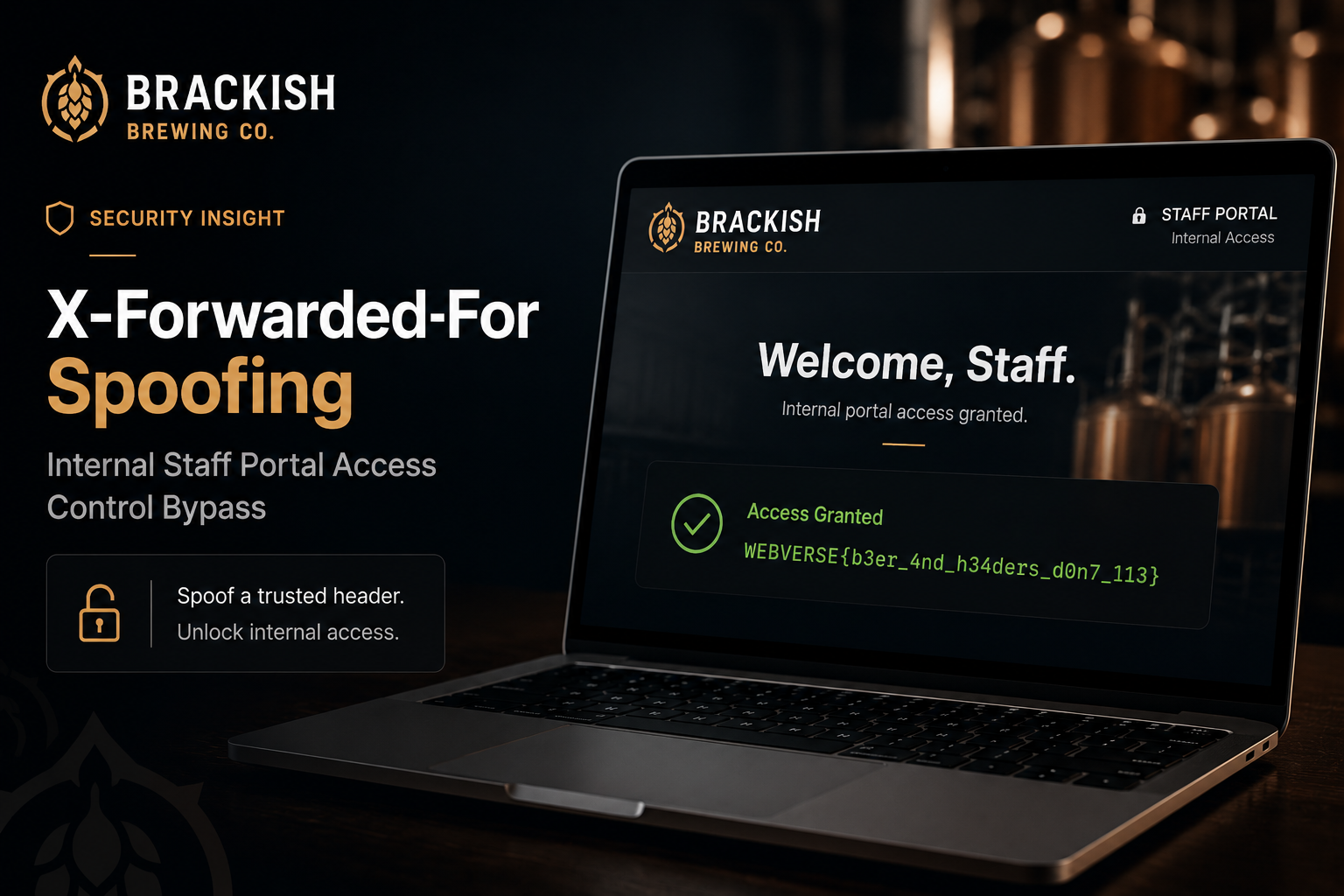
X-Forwarded-For Spoofing – Internal Staff Portal Access Control Bypass | Brackish Brewing Co.
Lab Link
Lab: Brackish Brewing Co.
Overview
The Brackish Brewing Co. challenge demonstrates an access control flaw caused by trusting client-controlled headers.
The staff portal was designed to permit access only from internal systems. The application relied on information supposedly added by a load balancer to determine whether requests originated from the internal network.
After infrastructure changes, the assumptions behind the implementation no longer matched reality. The application still trusted network information supplied through HTTP headers.
By spoofing the expected header value, it became possible to impersonate an internal request and bypass access restrictions.
Objective
Gain access to the staff-only portal and retrieve the flag.
Vulnerability Classification Hierarchy
1
2
3
4
5
OWASP Category
└── A01: Broken Access Control
    └── Trust Boundary Violation
        └── Header-Based Authentication Bypass
            └── X-Forwarded-For Spoofing
Reconnaissance
Initial application mapping revealed:
1
2
3
/tap-list

/visit
Additional directory enumeration identified:
1
/staff
Visiting:
1
/staff
returned:
1
2
3
4
5
6
7
403 · Forbidden · staff-portal

Staff portal — internal network access only.

This portal is internal-network only. If you're seeing this from a personal device, you'll need to access it from the Coalridge office VPN or hit it from the LB hostname — the cloud load balancer is supposed to mark the request as a trusted hop before it gets here.

If you are on the office VPN and still seeing this, grab Hollis. The new load balancer changed how it labels in-network requests after the migration, and the staff handler may be looking for the old loopback marker.
The error message disclosed several important details:
- Internal access restrictions existed
- Traffic relied on load balancer information
- Migration changes affected request handling
- The application expected a loopback marker
The message strongly suggested the application was trusting request metadata.
Analysis
Applications behind reverse proxies frequently use headers such as:
1
X-Forwarded-For
to identify client IP addresses.
Typical flow:
1
2
3
4
5
User
   ↓
Load Balancer
   ↓
Application
The application appeared to assume:
1
Requests with loopback IP = internal users
However:
1
HTTP headers are client controlled
unless explicitly rewritten and validated by a trusted proxy.
Exploitation
Burp Suite interception was enabled.
The request to:
1
GET /staff HTTP/2
was modified by adding:
1
X-Forwarded-For: 127.0.0.1
Modified request:
1
2
3
4
GET /staff HTTP/2
Host: target.com

X-Forwarded-For: 127.0.0.1
The modified request was forwarded to the server.
Proof of Exploitation
The application accepted the spoofed value and treated the request as internal traffic.
Request flow became:
1
2
3
4
5
6
7
Attacker Request
        ↓
X-Forwarded-For: 127.0.0.1
        ↓
Application trusts header
        ↓
Access granted
The browser displayed the staff portal successfully.
Scrolling through the page revealed:
1
WEBVERSE{.....}
Access restrictions were completely bypassed.
Root Cause
The application likely implemented logic similar to:
1
2
3
4
5
if request.headers.get(
    "X-Forwarded-For"
) == "127.0.0.1":

    allow_staff_access()
The problem:
1
X-Forwarded-For
is supplied through HTTP requests and can be modified by users.
The application failed to:
- Verify trusted proxy sources
- Validate request origin
- Separate user input from infrastructure metadata
- Establish a secure trust boundary
Impact
In real-world environments this issue can lead to:
- Administrative portal access
- Authentication bypass
- Internal API exposure
- Sensitive information disclosure
- Privilege escalation
- Complete application compromise
Internal panels frequently assume network location equals trust.
Attackers can exploit that assumption.
Mitigation
Never trust client-supplied forwarding headers directly
Bad:
1
2
if request.headers["X-Forwarded-For"]=="127.0.0.1":
    allow()
Secure:
1
2
if request.remote_addr in trusted_proxies:
    client_ip = extract_verified_ip()
Configure trusted proxy chains
Only accept forwarding information from known infrastructure components.
Use authentication instead of network assumptions
Replace:
1
Internal IP = trusted user
with:
1
Authenticated user + authorization checks
Strip untrusted forwarding headers
Reverse proxies should overwrite:
1
2
3
X-Forwarded-For
X-Real-IP
Forwarded
rather than preserving user-supplied values.
Real-World Insight
Header spoofing issues commonly appear during penetration tests involving:
- Internal dashboards
- Administrative portals
- Legacy applications
- Reverse proxy migrations
- VPN-restricted systems
A frequent assumption is:
1
Nobody can modify X-Forwarded-For
Attackers interact directly with requests.
Anything originating from the client should be considered untrusted until validated.