SSRF – Internal Service Discovery Through Monitor Preview Feature | Statuscraft
Lab Link
Lab: Statuscraft
Overview
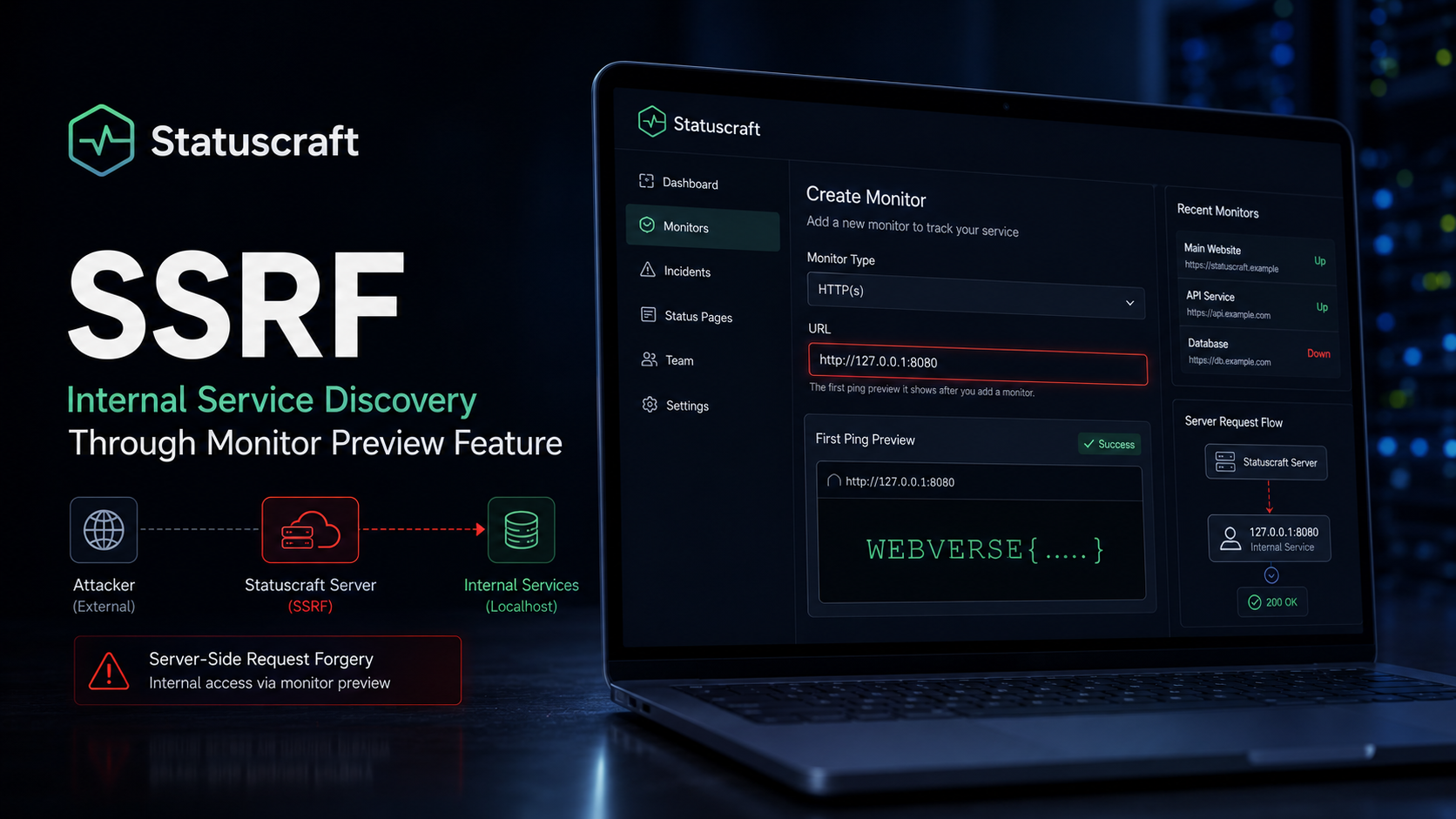
The Statuscraft challenge demonstrates a Server-Side Request Forgery (SSRF) vulnerability inside a monitor preview feature.
The application allowed users to add monitoring targets and displayed an immediate “first ping” preview before permanently saving the monitor. Instead of validating destinations, the backend fetched arbitrary user-supplied URLs.
Because requests originated from the server itself, internal resources normally inaccessible from external users became reachable.
Using SSRF, internal services were enumerated and hidden resources were discovered.
Objective
Exploit the monitor preview functionality to access internal services and retrieve the flag.
Vulnerability Classification Hierarchy
1
2
3
4
5
OWASP Category
└── A10: Server-Side Request Forgery (SSRF)
    └── SSRF
        └── Internal Network Enumeration
            └── Localhost Service Discovery
Reconnaissance
Registration was required before accessing monitor functionality.
Registration page:
1
https://abf6a460-4065-inside-line-f5816.challenges.webverselabs-pro.com/register
After registration, monitor creation functionality was available:
1
https://abf6a460-4065-inside-line-f5816.challenges.webverselabs-pro.com/monitors/new
The challenge description mentioned:
1
The first ping preview it shows after you add a monitor
This strongly suggested server-side URL fetching behavior.
Applications that retrieve arbitrary URLs frequently become SSRF candidates.
Initial Testing
Several localhost targets were tested:
1
2
3
4
5
6
7
http://127.0.0.1:3000

http://127.0.0.1:5000

http://127.0.0.1:8000

http://127.0.0.1:8080
Results:
1
2
3
127.0.0.1:5000 → Reachable

127.0.0.1:8080 → Reachable
This confirmed:
- Requests were processed server-side
- Internal services were accessible
- SSRF existed
Internal Service Discovery
Port enumeration through SSRF revealed multiple internal services.
Observed behavior:
1
127.0.0.1:5000
responded successfully.
Time was spent attempting endpoint discovery and enumeration against the service.
However, no useful content was identified.
Additional testing showed:
1
127.0.0.1:8080
also responding.
Unlike the first service, this endpoint directly exposed sensitive content.
Exploitation
Requesting:
1
http://127.0.0.1:8080
through the monitor preview functionality returned:
1
WEBVERSE{.....}
The application retrieved internal resources on behalf of the attacker.
Proof of Exploitation
Attack path:
1
2
3
4
5
6
7
8
9
10
11
12
13
Monitor Preview Feature
            ↓
Arbitrary URL Submission
            ↓
Server-Side Request
            ↓
Localhost Access
            ↓
Internal Port Enumeration
            ↓
Sensitive Service Discovery
            ↓
Flag Retrieval
The server became a proxy into its own internal network.
Root Cause
The application likely implemented functionality similar to:
1
2
3
response = requests.get(
    user_supplied_url
)
without validating destinations.
The application failed to:
- Restrict localhost access
- Block internal network ranges
- Filter sensitive destinations
- Validate request targets
As a result, users could force the server to access internal resources.
Impact
In real-world environments SSRF can lead to:
- Internal network enumeration
- Cloud metadata access
- API key disclosure
- Credential theft
- Internal application compromise
- Database exposure
- Remote code execution chains
Frequently targeted resources include:
1
2
3
4
5
6
7
8
9
AWS metadata service

GCP metadata service

Internal APIs

Administrative panels

Monitoring systems
Mitigation
Restrict request destinations
Allow requests only to approved domains:
Bad:
1
requests.get(user_url)
Secure:
1
2
if domain in approved_domains:
    requests.get(url)
Block internal IP ranges
Restrict:
1
2
3
4
5
127.0.0.0/8
10.0.0.0/8
172.16.0.0/12
192.168.0.0/16
169.254.0.0/16
Resolve hostnames before validation
Perform checks after DNS resolution.
1
2
3
4
5
6
7
URL
 ↓
DNS Resolution
 ↓
IP Validation
 ↓
Allow/Deny
Isolate outbound requests
Move URL fetching functionality into restricted environments with limited network access.
Real-World Insight
Features frequently vulnerable to SSRF include:
- URL previews
- Webhooks
- File importers
- PDF generators
- Monitoring systems
- Analytics integrations
Developers commonly assume:
1
Users only submit public URLs
Attackers routinely target:
1
2
3
4
localhost
internal APIs
cloud metadata
private services
Server-side URL fetchers often become internal network proxies when proper restrictions are absent.